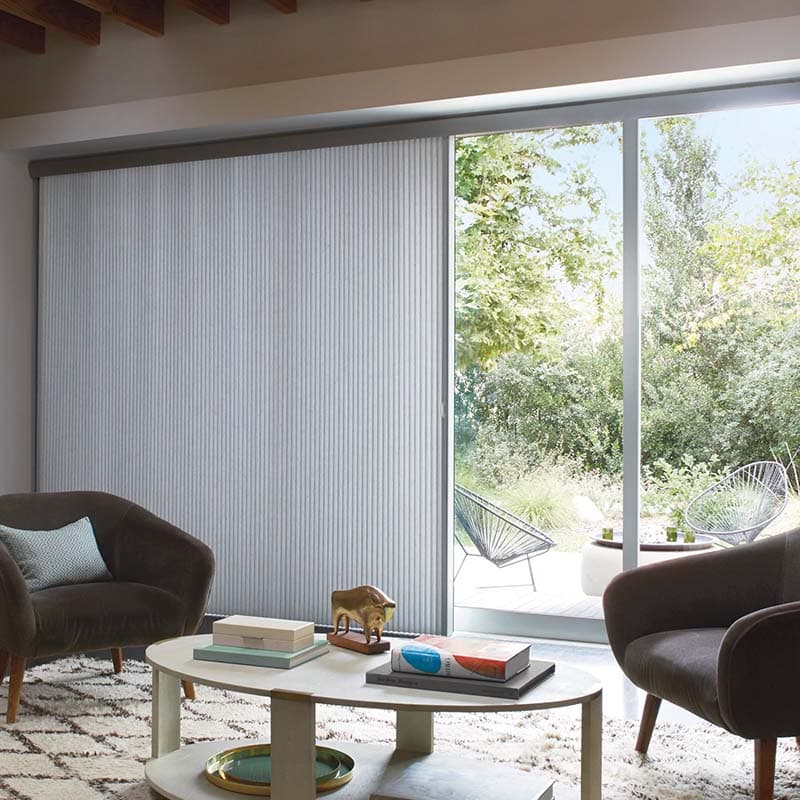
To protect furniture from sun damage, stop the light before it reaches the piece. Cover sunny windows with UV-filtering shades or shutters during the hours of direct sun, move or rotate furniture out of the beam, and consider UV window film or low-e glass on windows you never want to cover.
The window covering does most of the work, because it controls the light every single day. Habits and film fill in the gaps. Here is what causes fading, which coverings block the most UV, and where to start in a Colorado home.
Key Takeaways
- Fading comes from UV rays, visible light, and solar heat, and the damage adds up over time and cannot be undone.
- Castle Rock sits above 6,000 feet, where UV is roughly 12% stronger than at sea level.
- Solar screen shades keep your view and block up to 99% of UV, according to Hunter Douglas. Closed coverings of any kind block more than open ones.
- Simple habits help: rotate pieces, use top-down shades, and let motorized shades close on a schedule.
- Window film reflects most UV and keeps the view, but it does little for insulation and has a few cautions.
What causes furniture to fade in the sun?
Furniture fades because light breaks down the dyes and finishes that give it color. The Library of Congress explains that UV rays break chemical bonds in dyes, and that visible light and solar heat are other major contributors to fading (Library of Congress, "Why does ultraviolet light cause color to fade?").
Two facts from museum conservators matter most for your living room. Light damage is cumulative and irreversible, and it depends on how bright the light is multiplied by how long it lasts. Daylight is also generally the strongest source of UV in a building (American Museum of Natural History, "Light, Ultraviolet, and Infrared").
In plain terms, a sofa in a sunny window does not fade all at once. It fades a little every afternoon, and the color does not come back. That is why cutting the daily dose matters more than any one fix.
It is not only fabric. Hunter Douglas notes the sun can also bleach and dry out wood furniture, and break down stain, paint finishes, and joint sealants (Hunter Douglas, "The Right Shades Can Protect Your Furnishings," retrieved 2026-11-09). Floors, rugs, and art fade the same way.
Is sun damage worse in Colorado?
Yes. UV gets stronger as you go higher. The EPA notes that UV rises about 2% for every 1,000 feet of elevation (EPA, "A Guide to the UV Index"). Castle Rock sits at 6,202 feet (Visit Castle Rock), so by that rule of thumb our windows see roughly 12% more UV than the same window at sea level.
Add our sunny climate and the big south- and west-facing windows in many new builds, and fading happens faster than people expect. The rooms that get hours of direct afternoon sun are the ones to protect first.
Which window coverings block the most UV?
Solar screen shades are built specifically to block UV while keeping your view. Hunter Douglas says its Designer Screen Shades block up to 99% of UV rays (Hunter Douglas, "How do I find what levels of energy efficiency, UV protection, privacy and light control my window coverings provide?," retrieved 2026-11-09). Hunter Douglas also notes that every window covering gives some UV protection, and that protection increases when it is fully closed.
That leaves a real tradeoff between protection, view, and daylight. Here is how the main options compare.
| Option | UV protection | View kept | Light kept |
|---|---|---|---|
| Solar (screen) shades | High. Up to 99% for Hunter Douglas Designer Screen | Yes, filtered | Yes, glare cut |
| Sheer shadings (Silhouette®, Pirouette®) | Filters UV with vanes open; more when closed | Yes, softened | Yes, diffused |
| Cellular (honeycomb) shades | Good when lowered; depends on the fabric | No when lowered (top-down helps) | Light-filtering keeps a glow; room-darkening does not |
| Plantation shutters | High with louvers closed; partial when tilted | Yes with louvers open | Adjustable |
| Room-darkening or blackout shades | Highest when closed | No | No |
| UV window film | Reflects most UV | Yes | Mostly; tinted films cut some light |
| Low-e windows | Blocks about 75% of the UV standard glass lets through | Yes | Yes |
Here is how to read that table for your rooms.
Solar and roller shades: protection without losing the view
Solar shades are roller shades with a fabric woven just tight enough to protect against UV (Hunter Douglas, "Solar Shades for Windows," retrieved 2026-11-09). They are the go-to for a family room with a view you do not want to give up. Darker fabrics cut glare and give a clearer view out. Lighter fabrics reflect more heat and brighten the room but look a little hazier. You can compare fabrics on our shades page.
Sheer shadings: soft light and UV filtering
Silhouette® and Pirouette® shadings float fabric vanes between sheers. Hunter Douglas describes them as blocking UV while letting natural light in and keeping your view (Hunter Douglas, "UV-Blocking Window Treatments," retrieved 2026-11-09). They suit living rooms where you want a glow all day. Close the vanes during peak sun for more protection.
Cellular shades: protection plus insulation
Duette® cellular shades cover the glass and add a layer of insulation, so they help with heat as well as fading. They come in light-filtering through room-darkening fabrics. The tradeoff is the view, since a lowered shade covers it. A top-down/bottom-up version lets you keep the sky and cover the lower glass where sun lands on the furniture.
Plantation shutters: adjustable and permanent
Closed louvers block most direct sun, and you can tilt them to aim light up toward the ceiling and away from the sofa. Light can still slip between louvers, so they are not total blackout. If a south- or west-facing room is the problem, ask about Palm Beach™ polysatin shutters, which Hunter Douglas makes to be UV resistant. See our shutters page for materials.
What everyday habits protect furniture from the sun?
The simplest protection is changing how long the sun sits on a piece. Because light damage adds up with time, small daily changes really do add up.
- Close coverings on the sunny side during peak hours. The U.S. Department of Energy recommends using blinds or curtains on south- and west-facing windows to block strong summer sun (U.S. Department of Energy, "Energy-Saving Hacks To Beat the Summer Heat"). It helps your furniture and your cooling bill.
- Move or rotate pieces. Shift a sofa out of the afternoon beam, flip cushions, and turn rugs every few months so wear and fading stay even.
- Use top-down/bottom-up shades. Lower the top for daylight and keep the bottom covered where sun hits the furniture.
- Let a schedule do it. Motorized shades can close on their own at the hours your room gets hit, even when nobody is home. That is the habit people actually keep. Our motorization page shows how schedules work.
- Cover what you cannot move. A throw over the sunny arm of a sofa or a runner on a sunny floor takes the hit instead.
Fabric protectant sprays are also sold for this. Check the furniture maker's care instructions before you use one, and treat a spray as a backup to blocking the light, not a replacement.
Is window film a good alternative to window coverings?
Window film is a good choice for a window you never want to cover, like a transom or a big picture window with a view. Window film reflects most UV and helps reduce fading (Efficient Windows Collaborative, "Window Film", retrieved 2026-11-09).
Be honest with yourself about its limits, though. Film does little for insulation, so it will not help with winter heat loss the way a cellular shade does. It does not give you privacy or darkness either. Film applied to the inside of the glass also raises the glass temperature, which can stress the glass or its seals on sunny but cold days. That is a real Colorado condition. Check your window warranty before installing film, and have a film professional look at your glass first (Efficient Windows Collaborative, "Window Film," retrieved 2026-11-09).
Newer low-e windows are the bigger fix. Their coatings block about 75% of the UV that standard glass lets through (Efficient Windows Collaborative, "Protect Your Art and Furniture", retrieved 2026-11-09). That makes sense when you are replacing windows anyway, but it is a much bigger project than a shade.
Film, glass, and coverings work well together. Film or low-e glass cuts the UV all the time, and a shade or shutter handles the hours of hardest sun.
Where should you start?
Start with your sunniest room, usually the one with big west- or south-facing glass. Look at what sits in the afternoon beam: the sofa, the rug, the wood floor, the art. That is your priority window.
The same windows usually drive your heating and cooling swings, so one choice can solve both. Our energy-efficiency page covers the insulation side, and our post on untreated windows and sun covers what a bare window lets in.
We can look at your exposure, bring samples to your windows, and show you how much light each option keeps. If a simple habit change would do the job, we will tell you. Book a free in-home consultation to get started.
Frequently asked questions
- Do blinds and shades really protect furniture from fading?
- Yes. Every window covering gives some UV protection, and the protection increases when it is fully closed, according to Hunter Douglas. Solar screen shades are built for it. Hunter Douglas says its Designer Screen Shades block up to 99% of UV rays while keeping your view.
- Can furniture fade through a closed window?
- Yes. Standard glass blocks some UV but not all of it, and visible light and solar heat also cause fading. Low-e coatings block about 75% of the UV that standard glass lets through, according to the Efficient Windows Collaborative. A covering adds protection during the hours of direct sun.
- Can sun-faded furniture be restored?
- Usually not. Museum conservators describe light damage as cumulative and irreversible. Refinishing or reupholstering can replace the faded surface, but the faded dye itself does not come back. That is why it pays to block the light early.
- Is UV window film better than shades?
- It depends on the window. Film reflects most UV and keeps the view all day, so it suits windows you never cover. But it does little for insulation, gives no privacy, and can stress glass on sunny, cold days. Shades add insulation, privacy, and light control. Many homes use both.
- Why does furniture fade faster in Colorado?
- UV gets stronger with elevation. The EPA notes UV rises about 2% for every 1,000 feet, and Castle Rock sits at 6,202 feet. That works out to roughly 12% more UV than at sea level, on top of a sunny climate.
Sources
- Archived Value Blinds & Shutters, "How to Protect Furniture From Sun Damage" (original 2023 article) (retrieved 2026-11-09)
- Library of Congress, "Why does ultraviolet light cause color to fade?" (UV, visible light, and solar heat cause fading) (retrieved 2026-11-09)
- American Museum of Natural History, "Light, Ultraviolet, and Infrared" (light damage is cumulative and irreversible) (retrieved 2026-11-09)
- U.S. EPA, "A Guide to the UV Index" (UV rises about 2% per 1,000 feet) (retrieved 2026-11-09)
- Visit Castle Rock, "About Castle Rock" (elevation 6,202 feet) (retrieved 2026-11-09)
- Hunter Douglas, "How do I find what levels of energy efficiency, UV protection, privacy and light control my window coverings provide?" (Designer Screen blocks up to 99% of UV) (retrieved 2026-11-09)
- Hunter Douglas, "UV-Blocking Window Treatments" (sheer shadings and solar shades; protection increases when closed) (retrieved 2026-11-09)
- Hunter Douglas, "The Right Shades Can Protect Your Furnishings" (sun damage to wood finishes and fabrics) (retrieved 2026-11-09)
- Hunter Douglas, "Palm Beach Polysatin Shutters" (UV resistance) (retrieved 2026-07-10)
- Hunter Douglas, "Solar Shades for Windows" (fabric weave and color) (retrieved 2026-11-09)
- U.S. Department of Energy, "Energy-Saving Hacks To Beat the Summer Heat" (retrieved 2026-11-09)
- Efficient Windows Collaborative, "Window Film" (reflects most UV; little insulation; glass stress caution) (retrieved 2026-11-09)
- Efficient Windows Collaborative, "Protect Your Art and Furniture" (low-e coatings and UV) (retrieved 2026-11-09)
About the author
Lucas Campbell · Business Development, Value Blinds & Shutters
Lucas Campbell joined Value Blinds & Shutters full time in 2023 and works with homeowners across Castle Rock and the Front Range. Value Blinds is the only Hunter Douglas showroom for interior window coverings in Castle Rock and an authorized Hunter Douglas dealer since 2003.