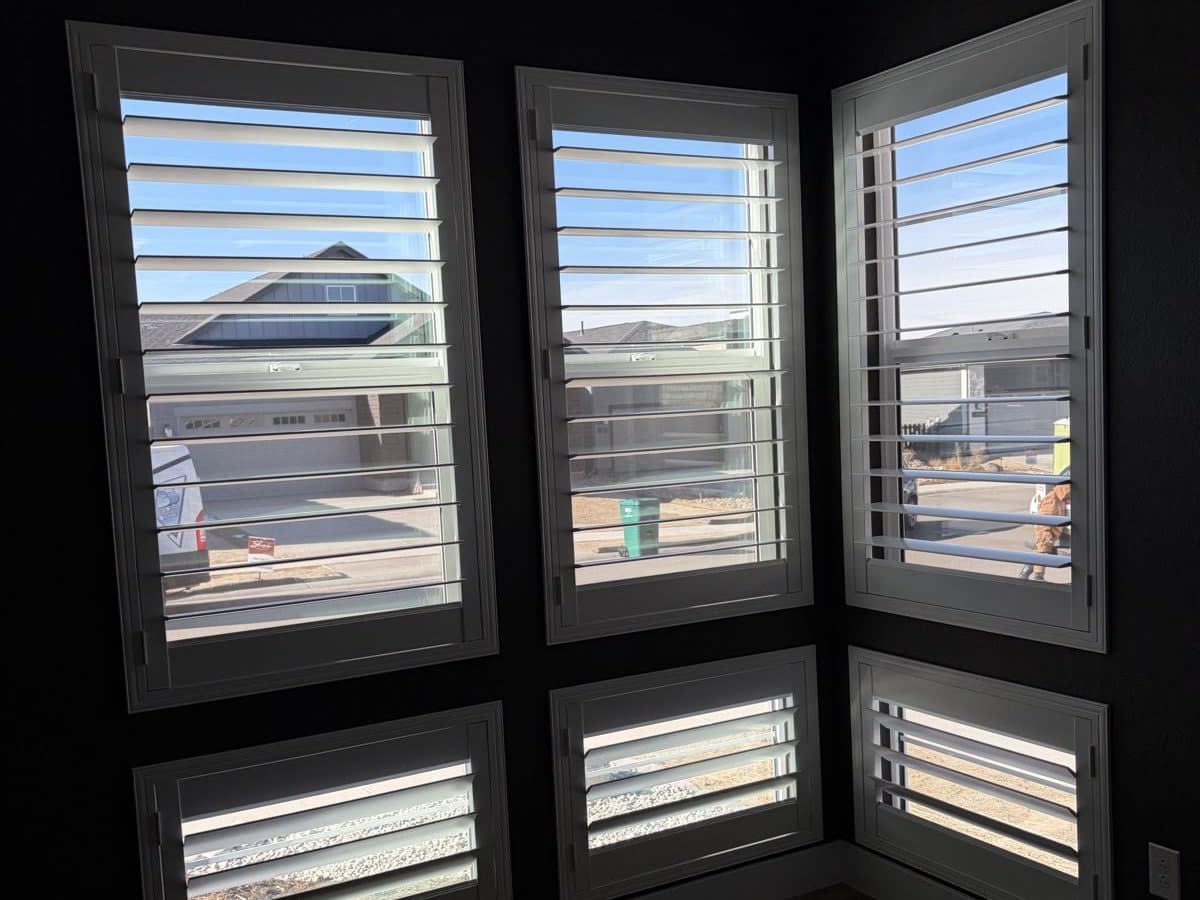
Somewhere in a shutter consultation, the conversation turns technical. Inside mount or outside mount? L-frame or Z-frame? Full height or tier-on-tier? These are good questions, and the answers change how your shutters look, how they open, and how much light they let in.
This guide explains each choice in plain language, so you can walk into that conversation knowing what you want and why.
Key Takeaways
- An inside mount sits within the window opening for a clean, built-in look. It needs enough depth and a reasonably square opening.
- An outside mount sits on the wall or trim around the window. It suits shallow openings, windows with no trim, and rooms where you want to cover more of the window.
- The frame is the border the shutter panels hang in. Its profile decides how the shutter meets your trim or wall.
- Panel layout, meaning full height, cafe, or tier-on-tier, decides how you get privacy and light from the same window.
What are the plantation shutter frame types?
Every plantation shutter comes down to three choices. First, where it mounts: inside the window opening or outside it. Second, the frame profile: the shape of the border that holds the panels and meets your trim or wall. Third, the panel layout: how the panels divide the window from top to bottom.
The window itself usually narrows these choices quickly. Its depth, its trim, and whether anything sticks out of the frame do most of the deciding. The rest comes down to the look you want.
Inside mount vs outside mount
Inside mount
An inside-mount shutter fits within the window opening, so the frame sits inside the casing. It is the look most people picture when they think of plantation shutters, clean and built in, and it shows off decorative trim around the window. Hunter Douglas recommends an inside mount for shutters when you have decorative trim you want to show off (Hunter Douglas, "Inside vs. Outside Mount," retrieved 2026-10-01).
An inside mount asks two things of the window. It needs enough depth for the frame and for the louvers to tilt, and it works best when the opening is reasonably square. Anything that sticks out, such as locks, handles, or casement cranks, can keep a window treatment from hanging or working properly inside the opening (Hunter Douglas, "Inside vs. Outside Mount," retrieved 2026-10-01).
Outside mount
An outside-mount shutter attaches to the wall or the trim around the opening rather than fitting inside it. Hunter Douglas suggests an outside mount for shutters when there is no trim to show off, or when you are covering a door with a very shallow frame (Hunter Douglas, "Inside vs. Outside Mount," retrieved 2026-10-01).
An outside mount can also make a window look larger, hide trim you would rather not see, and dress an odd-shaped window. Because it covers the whole opening, it blocks more light than a treatment mounted inside the casing (Hunter Douglas, "Inside vs. Outside Mount," retrieved 2026-10-01). It does sit proud of the wall, so make sure doors, cabinets, or furniture nearby will not get in the way of the panels as they swing open.
Inside or outside: side by side
| What matters | Inside mount | Outside mount |
|---|---|---|
| Look | Built in, framed by your existing trim | Framed by the shutter frame itself, sits on the wall or trim |
| Window depth | Needs enough depth for the frame and louver tilt | Works on shallow openings |
| Trim | Shows off decorative trim | Covers plain or worn trim, or works where there is none |
| Handles and cranks | Can get in the way | Usually clears them |
| Light | Small gaps at the edges are possible | Covers the whole opening, blocks more light |
| Window size | Keeps the window its true size | Can make a window look larger |
Neither one is better across the board. Many homes use both, an inside mount where the trim deserves to be seen and an outside mount where the window is shallow or the trim is plain. We decide window by window, not for the whole house at once.
Frame styles at a glance
The frame is the border the panels hang in. Its profile, meaning the shape you would see if you cut it in cross section, decides how the shutter meets the window. Names vary a little from one manufacturer to the next, so treat these as the common categories. When we measure, we confirm which frame profiles work for the shutter line you choose.
| Frame | What it looks like | Usually best for |
|---|---|---|
| L-frame | A slim profile shaped like the letter L, with a small lip that finishes the edge | Most inside mounts with enough depth, and outside mounts on flat trim |
| Z-frame | A stepped profile that sits in the opening and steps out onto the face of the wall or trim, so it looks like a piece of trim | Windows where you want the shutter to look framed, or openings that are a little out of square |
| Decorative frame | A wider profile with a molded face that acts as the window's casing | Outside mounts on windows with no trim, or trim you want to cover |
| Bullnose frame | A frame with a rounded edge | Windows with drywall returns that have rounded corners instead of wood casing |
That last one matters more than it sounds. Many newer homes have drywall returns, where the wall wraps into the window opening with no wood casing at all, often with rounded corners. A frame that matches that edge looks like it belongs to the house. A frame that fights it looks added on.
Full height, cafe, or tier-on-tier?
Once the mount and frame are set, the panel layout decides how you live with the window every day.
- Full height. One panel runs from the top of the window to the bottom. It is the cleanest look and the most common choice.
- Full height with a divider rail. A horizontal rail splits the louvers so the top and bottom halves tilt on their own. Close the bottom half for privacy and leave the top half open for daylight, which works well in bedrooms and bathrooms (Hunter Douglas, "Why You Need Indoor Window Shutters," retrieved 2026-10-01).
- Cafe style. Panels cover only the lower part of the window and leave the top open. It gives street-level privacy and keeps the upper glass bright.
- Tier-on-tier. Two separate sets of panels, one stacked above the other, each opening on its own. You can swing the top panels fully open for light and air while the bottom panels stay closed.
Shutter panels are hinged, so they swing open and let you open the window behind them (Hunter Douglas, "Hinged Shutter Panels," retrieved 2026-10-01). For sliding and French doors, panels can run on a track instead. A bi-fold track lets the panels fold like a fan, and a bypass track lets them slide past each other so you get the full view (Hunter Douglas, "Why You Need Indoor Window Shutters," retrieved 2026-10-01).
Louver size and the frame
Louver size and mounting go hand in hand, because the louvers need room to tilt inside the frame. The Hunter Douglas shutter lines we sell, Heritance hardwood, NewStyle hybrid, and Palm Beach polysatin, all come with 2.5 inch, 3.5 inch, or 4.5 inch louvers (Hunter Douglas, Heritance, NewStyle, and Palm Beach product pages, retrieved 2026-10-01). Larger louvers suit larger windows and give more view through, while smaller louvers suit smaller windows and read more traditional (Hunter Douglas, "Why You Need Indoor Window Shutters," retrieved 2026-10-01).
A deeper louver can change whether an inside mount works in a shallow opening, which is one more reason we measure before anyone picks a size from a photo.
Special windows
Arches, angles, and other odd shapes can take shutters too, because custom shutters are built to fit almost any window shape (Hunter Douglas, "Why You Need Indoor Window Shutters," retrieved 2026-10-01). These windows usually call for their own frame and mounting plan. See our specialty shapes work for the kinds of windows we fit.
If darkness is the goal in a bedroom or media room, mounting is part of the answer, since an outside mount covers more of the opening. Shutters still let some light through between the louvers, so a dark room usually means pairing them with a shade. Our room-darkening options cover that side of it.
How we pick the right frame for your window
You do not have to settle any of this before we arrive. In one free in-home appointment, we measure each window, check its depth and how square it is, look for handles and cranks, and look at the trim or drywall around it. Then we recommend a mount, a frame, and a panel layout for each window, and give you a price on the spot.
Our own salaried installers, not subcontractors, hang the shutters, and you get a photo of your installer before they arrive. Every shutter carries a lifetime product warranty, plus free in-home service for 5 years. We are the only Hunter Douglas showroom for interior window coverings in Castle Rock, and an authorized Hunter Douglas dealer since 2003, so you can also come see shutters in person at 735 Park Street.
The bottom line
Inside mount gives the cleanest, built-in look when the window has the depth and the trim for it. Outside mount handles shallow openings, plain or missing trim, and rooms where you want to cover more of the window. The frame profile decides how the shutter meets your wall, and the panel layout decides how you get privacy and light from the same window.
For the rest of the buying decisions, from materials to finishes, our plantation shutters buying guide walks through the full process. When you are ready, see our custom shutters or book a free in-home consultation.
Frequently asked questions
- Should plantation shutters be inside or outside mount?
- Inside mount when the window has enough depth, a reasonably square opening, and trim worth showing off. Outside mount when the opening is shallow, there is no trim or the trim is plain, a handle or crank is in the way, or you want to cover more of the window. Many homes use both, decided window by window.
- How much depth do I need for inside mount shutters?
- It depends on the shutter line and the louver size, because the louvers need room to tilt inside the frame. Rather than guess from a number online, we measure each window in one free in-home appointment and tell you which windows can take an inside mount.
- What is the difference between an L-frame and a Z-frame?
- An L-frame is a slim profile that suits most inside mounts and outside mounts on flat trim. A Z-frame steps out of the opening onto the face of the wall or trim, so it looks like trim and can help with openings that are a little out of square. Names vary by manufacturer, so we confirm the right frame for the line you choose at the in-home measure.
- Can you put shutters on a window with no trim?
- Yes. An outside mount with a decorative frame acts as the window's casing, and a bullnose frame suits drywall returns with rounded corners. Either way, the shutter can look like it was built with the house.
- What is the difference between tier-on-tier and a divider rail?
- A divider rail keeps one full-height panel but splits the louvers so the top and bottom tilt separately. Tier-on-tier uses two separate sets of panels, one above the other, so you can swing the top panels fully open while the bottom panels stay closed.
Sources
- Hunter Douglas, "Inside vs. Outside Mount" (inside mount for decorative trim; outside mount for no trim or shallow door frames; obstructions; outside mount covers the whole window and blocks more light) (retrieved 2026-10-01)
- Hunter Douglas, "Why You Need Indoor Window Shutters" (louver size and window size; split panels; bi-fold and bypass tracks; odd-shaped windows) (retrieved 2026-10-01)
- Hunter Douglas, "Hinged Shutter Panels" (retrieved 2026-10-01)
- Hunter Douglas, Heritance, NewStyle, and Palm Beach shutter product pages (louver sizes 2.5, 3.5, and 4.5 inch) (retrieved 2026-10-01)
About the author
Lucas Campbell · Business Development, Value Blinds & Shutters
Lucas Campbell joined Value Blinds & Shutters full time in 2023 and works with homeowners across Castle Rock and the Front Range. Value Blinds is the only Hunter Douglas showroom for interior window coverings in Castle Rock and an authorized Hunter Douglas dealer since 2003.