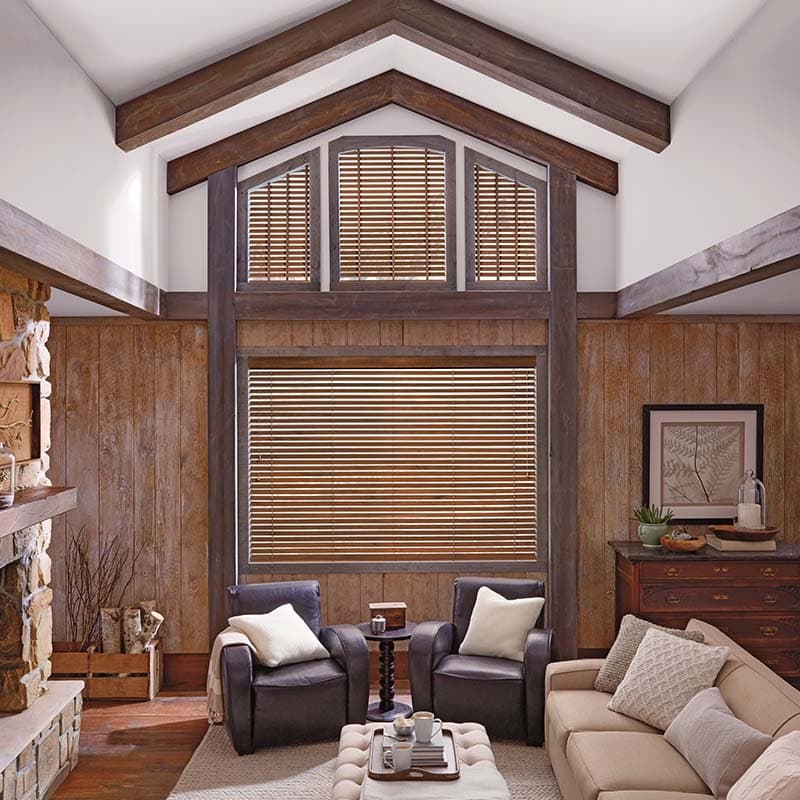
For most first-floor rooms, tilt horizontal blind slats up when privacy is the priority. The upward angle usually interrupts the view from outside at street level and sends daylight toward the ceiling, where it feels softer. Tilt the slats down when you want more light aimed toward the floor or a clearer view through the gaps.
That is the short answer, but window height, sun angle, and the position of people outside can change it. A blind is adjustable, not absolute. The best final check is to set the slats, turn on the room lights, and look through the window from the place you want to block.
What do “blinds up” and “blinds down” mean?
This guide is about horizontal slat blinds, including wood, faux-wood, and metal blinds. “Tilted up” means the slats are rotated so they direct incoming light toward the ceiling. “Tilted down” means they direct more light toward the floor.
Control wands and cords do not all turn in the same direction, so do not rely on which way your hand moves. Watch the light instead. If it washes the ceiling, the slats are up. If it falls more directly onto the floor, the slats are down.
The useful rule of thumb is simple: up usually favors privacy, softer light, and summer sun control; down favors more direct light and useful winter sun. Treat it as a starting point, because the window's height, the sun's angle, and the outside viewpoint can change the result.
Blinds up vs. blinds down at a glance
| Your priority | Try first | Why |
|---|---|---|
| First-floor daytime privacy | Tilt up | The angle usually blocks a direct street-level view into the room. |
| Softer daylight | Tilt up | Light is redirected toward the ceiling instead of the floor or your eyes. |
| Less screen glare | Tilt up, then fine-tune | The slats can interrupt the direct beam while preserving some daylight. |
| Brighter lower half of the room | Tilt down | More light is aimed toward the floor and work surfaces. |
| Enjoying useful winter sun | Open the blind or tilt down | Direct sun can enter when you want passive warmth. |
| Blocking strong summer sun | Close the blind; start tilted up | A more closed position matters more than the label “up” or “down.” |
| Strong room darkening | Close fully or add a room-darkening layer | Gaps between slats will still leak light. |
Use the table as a starting position, then move the slats a few degrees. Small adjustments can change privacy and glare without making the room feel closed off.
Should blinds face up or down for privacy on the first floor?
Start with the slats tilted up. From a normal street or walkway, a person outside is often lower than the window or looking straight toward it. The upward tilt breaks that sight line better than a downward tilt while still admitting some daylight.
The window's elevation can reverse the geometry. A basement window, a split-level room, or a home above a rising sidewalk may put the outside viewer higher than the glass. In those cases, the opposite angle may work better. This is why “always tilt up” is too broad.
Night changes the equation too. When the room is brighter than the outdoors, silhouettes and movement are easier to see through any open gap. For bedrooms, bathrooms, and windows close to a public walkway, close the slats fully and test them from outside after dark. If you still see through the edge gaps, pair the blind with a shade or drapery rather than trusting the slat angle alone.
For windows where privacy has to be dependable, our room-darkening options give you a more complete layer than a louvered blind can provide.
Which direction gives better light control?
Tilt up for softer, more diffuse light. The slats send daylight toward the ceiling, which spreads it across the room and can reduce a hard beam on a television or computer screen. It is a useful setting for living rooms, bedrooms, and home offices where you want daylight without staring into glare.
Tilt down when you want light on the lower part of the room. That can brighten a floor, desk, or reading area, but it may also create a sharper stripe of sun. Move the slats until the direct beam clears the place where you sit.
Slat color and finish also matter. A light surface usually reflects more light around the room, while a dark finish absorbs more and may look dimmer at the same angle. The sun's height changes through the day, so a setting that works at 9 a.m. may need another small turn at 4 p.m.
Which way blocks more light?
Neither direction guarantees a darker room. The darkest position is the one that closes the overlap between your specific slats most tightly. On many horizontal blinds that is the fully up-tilted position, but hardware, slat shape, and wear can change the result.
Check three places: the center of the blind, the side gaps, and the space above and below the headrail. If the center is dark but the perimeter glows, changing the tilt will not fix the real leak. A better fit or a second layer will.
Bedrooms and media rooms often need more than slat control. A blind can manage everyday daylight well, while a properly fitted room-darkening shade handles the gaps. Our guide to custom blinds can help you decide whether adjustable slats are still the right starting point.
Does blind direction matter for summer and winter heat?
It matters, but using the covering at the right time matters more. In warm weather, block direct sun before it heats the room. The U.S. Department of Energy recommends using blinds or curtains on southern- and western-facing windows to block strong summer rays and reduce added radiant heat (retrieved 2026-08-22).
For a sunny summer window, close the blind enough to stop the direct beam. Tilting up is often a comfortable first setting because it redirects remaining daylight toward the ceiling. If sunlight still reaches the floor or furniture, close the slats further. Do not chase a theoretical angle while a bright stripe is still entering the room.
In winter, useful sun can help warm a room during the day. Open the blind or tilt it down when sunlight is welcome, then close the covering after the sun moves away to reduce the cold feeling near the glass. A slat blind has gaps and is not a strong insulating layer, so the close fit and construction of the full window treatment matter more than the direction alone.
If comfort or seasonal heat control is the main goal, compare options on our energy-efficiency solution page. The right answer may be a cellular shade or layered treatment rather than a different blind angle.
How should you set blinds in different rooms?
Living room or street-facing front room
Begin tilted up for daytime privacy and softer light. Sit in the places you normally use and check for television glare. At night, close fully and verify the view from the sidewalk.
Home office
Use the slats to stop the direct beam before it reaches the screen. Up often works well because it preserves ceiling light, but a desk beside or above the window may need the opposite angle.
Bedroom or nursery
Privacy and darkness usually win. Close the slats tightly, then look for light around the sides. Add a room-darkening layer if sleep depends on a darker room.
Kitchen or dining room
Downward tilt can put useful daylight on counters and the floor. Change the angle if the beam creates glare on a stone counter or adds afternoon heat.
Second-floor room
Do not assume the first-floor rule applies. A person outside is usually looking up, so test both angles from the likely viewpoint. Trees, neighboring homes, and slopes all change the sight line.
A two-minute privacy and light test
- Set the blind to the angle that seems right from inside.
- Turn on the room lights, even if it is still daylight.
- Stand at the sidewalk, neighboring window, deck, or driveway you care about.
- Look from standing and seated height if both are realistic.
- Return inside and adjust the slats a few degrees.
- Repeat after dark for bedrooms, bathrooms, and first-floor rooms.
This test settles the question for your actual window. It also reveals whether the issue is the tilt, a side gap, or a blind that does not fit the opening.
The bottom line
Tilt horizontal blinds up for the usual first-floor mix of privacy, softer ceiling light, and summer glare control. Tilt them down when you want brighter light on the lower part of the room or want to admit winter sun. Then test the result from outside, because window height and surrounding ground can change the answer.
If no angle gives you the privacy, light control, or comfort you want, the blind may be solving the wrong problem. We can compare materials and layered options in your home during a free consultation, with no pressure to add what you do not need.
Frequently asked questions
- Are blinds supposed to be up or down?
- There is no single required direction. Tilt horizontal blinds up for more first-floor privacy and softer light toward the ceiling. Tilt them down for more direct light toward the floor. Window height and the outside viewpoint can change which angle works best.
- Should blinds face up or down for privacy?
- Up is usually the better first choice on a street-level window because it interrupts a direct view from outside while preserving daylight. It is not absolute. Close the slats, turn on the room lights, and check from the actual sidewalk or neighboring viewpoint, especially after dark.
- Which way do blinds block more light?
- Use the direction that closes the overlap between your slats most tightly. Many horizontal blinds close more tightly in the up position, but slat shape and hardware vary. If light comes through the sides or headrail, changing direction will not solve it; you may need a better fit or a room-darkening layer.
- Are blinds darker up or down?
- Often up, because the slats overlap tightly and redirect remaining daylight toward the ceiling. But the darkest result depends on the blind. Close it both ways and compare the center and edges of the window rather than relying on a universal rule.
- Which way should blinds face in summer?
- Start tilted up and close them enough to block the direct beam on hot, sunny windows. The Department of Energy recommends using blinds or curtains on southern- and western-facing windows to reduce strong summer sun. Timing and full coverage matter more than the direction label alone.
Sources
- Archived Value Blinds & Shutters, "Should I Tilt My Blinds up or Down?" (retrieved 2026-08-22)
- U.S. Department of Energy, "Energy-Saving Hacks To Beat the Summer Heat" (retrieved 2026-08-22)
About the author
Lucas Campbell · Business Development, Value Blinds & Shutters
Lucas Campbell joined Value Blinds & Shutters full time in 2023 and works with homeowners across Castle Rock and the Front Range. Value Blinds is the only Hunter Douglas showroom for interior window coverings in Castle Rock and an authorized Hunter Douglas dealer since 2003.