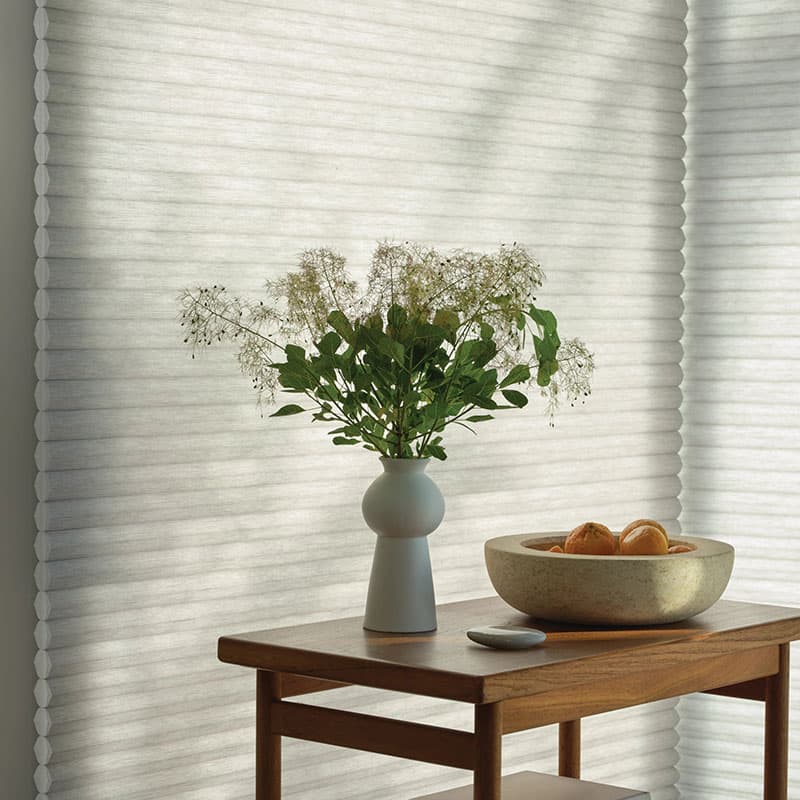
Hunter Douglas Duette honeycomb shades are fabric shades built from pleated cells that look like a honeycomb from the side. Each cell traps a pocket of air at the window. That air layer insulates against winter cold and summer heat, while the fabric filters light, adds privacy, and raises cordless or with PowerView motorization.
They are the shade we recommend most often when a room runs cold, hot, or both. They are not the right answer for every window, though. This guide covers how the cells work, which version to choose, how dark they get, and where we would steer you toward something else.
Key Takeaways
- Cellular shades trap air inside each cell and between the shade and the glass, which cuts nighttime heat loss and cold drafts (U.S. Department of Energy, retrieved 2026-11-09).
- In DOE-backed testing, cellular shades saved up to 20% on heating energy compared with no shades. That is a study result, not a promise for your bill.
- Duette is single-cell. Duette Architella is a cell within a cell, for windows where insulation matters most.
- Duette comes in light-filtering and room-darkening fabrics. LightLock side channels handle the light that leaks around the edges.
- The honest downsides: the cells collect dust and the odd bug, and a fabric shade will never have the built-in look of a plantation shutter.
How do honeycomb shades insulate a window?
They insulate by trapping still air. The U.S. Department of Energy explains that cellular shades hold air inside each cell and between the shade and the window. That layer slows heat moving through the glass, so the shade reduces nighttime heat loss, cold drafts near the window, and unwanted solar heat gain (U.S. Department of Energy, "Interior Cellular Shades Boost Home Energy Performance," retrieved 2026-11-09).
The same fact sheet reports that Lawrence Berkeley National Laboratory simulations found cellular shades reach higher energy savings than all other types of shading devices. Oak Ridge National Laboratory then tested five cellular shades and vinyl blinds in a real house. In that study, cellular shades saved up to 20% on heating energy and up to 15% on total heating and cooling energy, compared with no shades at all.
Two honest notes. The testing focused on the heating season, and DOE says more research is needed on cooling. And real results depend on the fit, the fabric, your climate, and whether the shade is actually closed when it needs to be. A shade with big gaps at the sides lets room air circulate against the cold glass, and that loses much of the benefit.
What is the R-value of a honeycomb shade?
There is no single R-value for honeycomb shades, and we will not quote one. Neither the DOE fact sheet nor the Hunter Douglas product information we checked lists an R-value for Duette. Performance changes with the cell construction, the fabric, and how the shade fits the opening.
The more useful number is an AERC rating. The Attachments Energy Rating Council labels tested window coverings with a cool-climate rating, for heating, and a warm-climate rating, for cooling. The label also lists a U-factor, where lower means less heat loss (U.S. Department of Energy, retrieved 2026-11-09). Hunter Douglas says select Duette styles were the first honeycomb shades rated by AERC (Hunter Douglas, "Single-Cell vs. Cell-within-a-Cell Window Shades," retrieved 2026-11-09). If energy is the reason you are buying, ask us for the rating on the exact fabric you are looking at.
Single-cell or cell-within-a-cell: which Duette do you need?
Most rooms do well with standard single-cell Duette. Choose Duette Architella, the cell-within-a-cell version, for big banks of glass or rooms that swing hard between hot and cold.
Hunter Douglas describes the difference simply. A single-cell shade traps air in one pocket. Architella nests a second cell inside the first, so it traps air between more layers. Hunter Douglas calls cell-within-a-cell shades like Architella the most energy-efficient shades it makes, and the right choice when you have many windows or live with weather extremes (Hunter Douglas, "Single-Cell vs. Cell-within-a-Cell Window Shades," retrieved 2026-11-09).
Duette also comes in two pleat sizes, 3/4 inch and 1 1/4 inch (Hunter Douglas, "Duette Honeycomb Shades," retrieved 2026-11-09). We bring both to the consultation, so you can see which one suits the scale of your windows.
How dark can Duette shades get?
Duette goes from soft, light-filtering fabric to room-darkening fabric, and that covers most bedrooms. For the darkest result, pair a room-darkening Duette with LightLock.
The reason is the edges. A dark fabric stops light coming through the shade, but light still slips around its sides. That is why a bedroom can be bright at six in the morning with the shade down. LightLock adds U-shaped side channels that blend into the window frame and absorb or deflect the incoming light (Hunter Douglas, "LightLock," retrieved 2026-11-09). We used Duette with LightLock in a primary bedroom in The Canyons in Castle Pines, where the homeowners wanted a room dark enough to actually sleep in.
| Duette option | What it does | Best for |
|---|---|---|
| Light-filtering fabric | Softens daylight and gives privacy while the room stays bright | Living rooms, kitchens, offices |
| Room-darkening fabric | Blocks the light coming through the fabric | Bedrooms, nurseries, media rooms |
| Room-darkening plus LightLock | Side channels block most of the light leaking around the edges | Light sleepers, shift workers, home theaters |
| Duolite | A light-filtering and a room-darkening fabric share one shade | Rooms that need daylight by day and darkness at night |
One honest word on "blackout." Hunter Douglas calls its darkest Duette fabrics room-darkening, and says LightLock keeps almost all light from seeping in (Hunter Douglas, "Different Types of Shades," retrieved 2026-11-09). Almost all is the honest promise. For more on dark bedrooms, see our room-darkening options.
What does top-down/bottom-up do?
Top-down/bottom-up lets the shade open from the top, the bottom, or both. Lower it from the top and daylight comes in over the window while the lower half stays closed for privacy.
Hunter Douglas offers Duette in top-down and top-down/bottom-up designs (Hunter Douglas, "Duette Honeycomb Shades," retrieved 2026-11-09). It is our usual pick for street-facing bedrooms, bathrooms, and front rooms where you want light without being on display. You get daylight and privacy from the same shade, with no second layer.
Can Duette shades be motorized with PowerView?
Yes. Duette works with PowerView motorization, so the shades can move by remote, by app, by voice, or on a schedule you set once. PowerView works with Amazon Alexa, Google Assistant, and Apple Home.
Motorization also helps a honeycomb shade do its energy job. A scheduled shade closes before the hard afternoon sun reaches the room and on cold evenings, even when nobody is home to remember. Many PowerView shades run on a rechargeable battery wand, so no electrician is needed. In a new build we can plan hardwired power before the drywall goes up. Hunter Douglas's own manufacturer warranty covers motorized components for 5 years from purchase. That is separate from our lifetime product warranty and 5 years of free in-home service.
In our Montaine project in Castle Rock, we put motorized Duette shades across the rear of the home, where the views and the efficiency mattered most. For the full picture, read our guide to motorized window coverings or see PowerView motorization.
Are honeycomb shades better than roller shades or plantation shutters?
For insulation, a well-fitted honeycomb shade usually leads among these three. For a built-in look, shutters win. Roller shades sit in between, with the cleanest, flattest look but less insulation.
| Duette honeycomb shade | Roller shade | Plantation shutters | |
|---|---|---|---|
| Insulation | Strongest of the three; cells trap air at the glass | Usually modest, unless it is a cellular roller like Sonnette | A solid layer across the window; depends on fit, not rated here |
| Light control | Light-filtering to room-darkening, plus LightLock and top-down/bottom-up | Sheer to opaque fabrics; screen fabrics keep the view | Tilt the louvers for fine control; light gets through at the louvers and seams |
| Look | Soft, pleated fabric | Flat, minimal panel | Architectural and built-in; part of the trim |
| Main tradeoff | Cells collect dust and bugs; a softer look | Light gaps at the edges; less insulation | Never fully dark; panels need room to swing open |
You don't have to pick one for the whole house. Montaine used shutters on the front for privacy and curb appeal, and Duette at the back for the views. For the shutter side, see plantation shutters and how much light shutters block. For a wider energy comparison, read what are the most energy-efficient blinds.
What are the downsides of Duette shades?
The biggest one is upkeep. Honeycomb cells are open at the ends, so dust settles inside and the odd insect crawls in and gets stuck.
It is manageable. Hunter Douglas recommends light, regular dusting and gentle vacuuming with a brush attachment. For bugs caught in the cells, it says not to push them out with a stick or wand, which can damage the fabric. Blow them out with a can of compressed air or a hair dryer on a cool setting instead. Some fabrics are treated to repel dust, so check the care guide for yours (Hunter Douglas, "How to Clean Cellular Shades?," retrieved 2026-11-09).
The other tradeoffs are about look and expectations:
- A softer look. Duette is fabric. If you want the "hard," built-in look of painted trim, shutters do that and a shade never will.
- The view goes away when it is closed. Light-filtering fabric glows, but you can't see out. Top-down/bottom-up helps. A screen shade keeps the view better.
- Not total darkness. Even with LightLock, the honest promise is almost all light, not every last ray.
Where do Duette shades fit in a Castle Rock home?
Duette earns its keep where Colorado weather hits hardest. That means rooms with real winters on one side of the glass and hot, high-altitude sun on the other.
- West- and south-facing rooms. They swing the most in temperature, so they return the most from an insulating shade.
- Great-rooms with big glass. Large windows lose and gain heat fast. Consider Architella and motorization here.
- Bedrooms and nurseries. Room-darkening Duette with LightLock gives you darkness and insulation in one shade.
- Street-facing rooms. Top-down/bottom-up keeps the daylight and the privacy.
Start with your worst rooms. You don't need Duette on every window to feel the difference.
See Duette in person
Honeycomb fabrics look different in your hand than on a screen. Stop by our Castle Rock showroom to feel the fabrics and try LightLock and PowerView. We are Castle Rock's only Hunter Douglas showroom for interior window coverings, and an authorized Hunter Douglas dealer since 2003. Browse our custom shades, or book a free in-home consultation. We will measure, recommend, and give you a price in one appointment. Your shades come with a lifetime product warranty, plus free in-home service for 5 years.
Frequently asked questions
- Are Duette honeycomb shades worth it for energy efficiency?
- For cold or sun-heated rooms, usually yes. DOE-backed testing found cellular shades saved up to 20% on heating energy compared with no shades, and more than conventional vinyl blinds. Your result depends on the window, the fit, the fabric, and whether the shade is closed when it matters, so we start with your worst rooms.
- Do honeycomb shades block all light?
- Not completely. Room-darkening Duette fabric blocks the light coming through the shade, but some light slips around the edges. LightLock side channels absorb or deflect most of that edge light. Hunter Douglas says LightLock keeps almost all light from seeping in, which is the honest promise.
- What is the difference between Duette and Duette Architella?
- Standard Duette is single-cell, so it traps air in one pocket. Architella nests a second cell inside the first, which traps more air. Hunter Douglas calls cell-within-a-cell shades like Architella its most energy-efficient shades, best for many windows or extreme weather.
- How do you clean honeycomb shades?
- Dust lightly and often, and vacuum gently with a brush attachment. To clear dust or bugs from inside the cells, Hunter Douglas recommends a can of compressed air or a hair dryer on a cool setting, never a stick or wand. Check the care guide first, since some fabrics are specially treated.
- Do plantation shutters or honeycomb shades insulate better?
- Honeycomb shades are built around trapped air, so they usually lead when insulation is the main goal. Shutters add a solid, durable layer and a built-in look, but how well they insulate depends on the fit. Many homes use both, with shutters for privacy and honeycomb shades where comfort matters most.
- Are Duette shades safe for kids and pets?
- They can be. Hunter Douglas offers cellular shades with cordless operating systems, and PowerView motorization removes cords altogether. For a child's room we recommend cordless or motorized every time.
Sources
- Hunter Douglas Help Center, "What is the warranty for motorized components?" (five-year limited warranty from purchase, original owner) (retrieved 2026-11-09)
- U.S. Department of Energy, "Interior Cellular Shades Boost Home Energy Performance" (retrieved 2026-11-09)
- Hunter Douglas, "Duette Honeycomb Shades" (pleat sizes, top-down/bottom-up, Duolite, Architella) (retrieved 2026-11-09)
- Hunter Douglas, "Single-Cell vs. Cell-within-a-Cell Window Shades" (Architella, AERC rating) (retrieved 2026-11-09)
- Hunter Douglas, "LightLock" (U-shaped side channels) (retrieved 2026-11-09)
- Hunter Douglas, "Different Types of Shades" (Duette opacities, LightLock, cordless cellular shades) (retrieved 2026-11-09)
- Hunter Douglas, "How to Clean Cellular Shades?" (dusting, removing bugs) (retrieved 2026-11-09)
About the author
Lucas Campbell · Business Development, Value Blinds & Shutters
Lucas Campbell joined Value Blinds & Shutters full time in 2023 and works with homeowners across Castle Rock and the Front Range. Value Blinds is the only Hunter Douglas showroom for interior window coverings in Castle Rock and an authorized Hunter Douglas dealer since 2003.