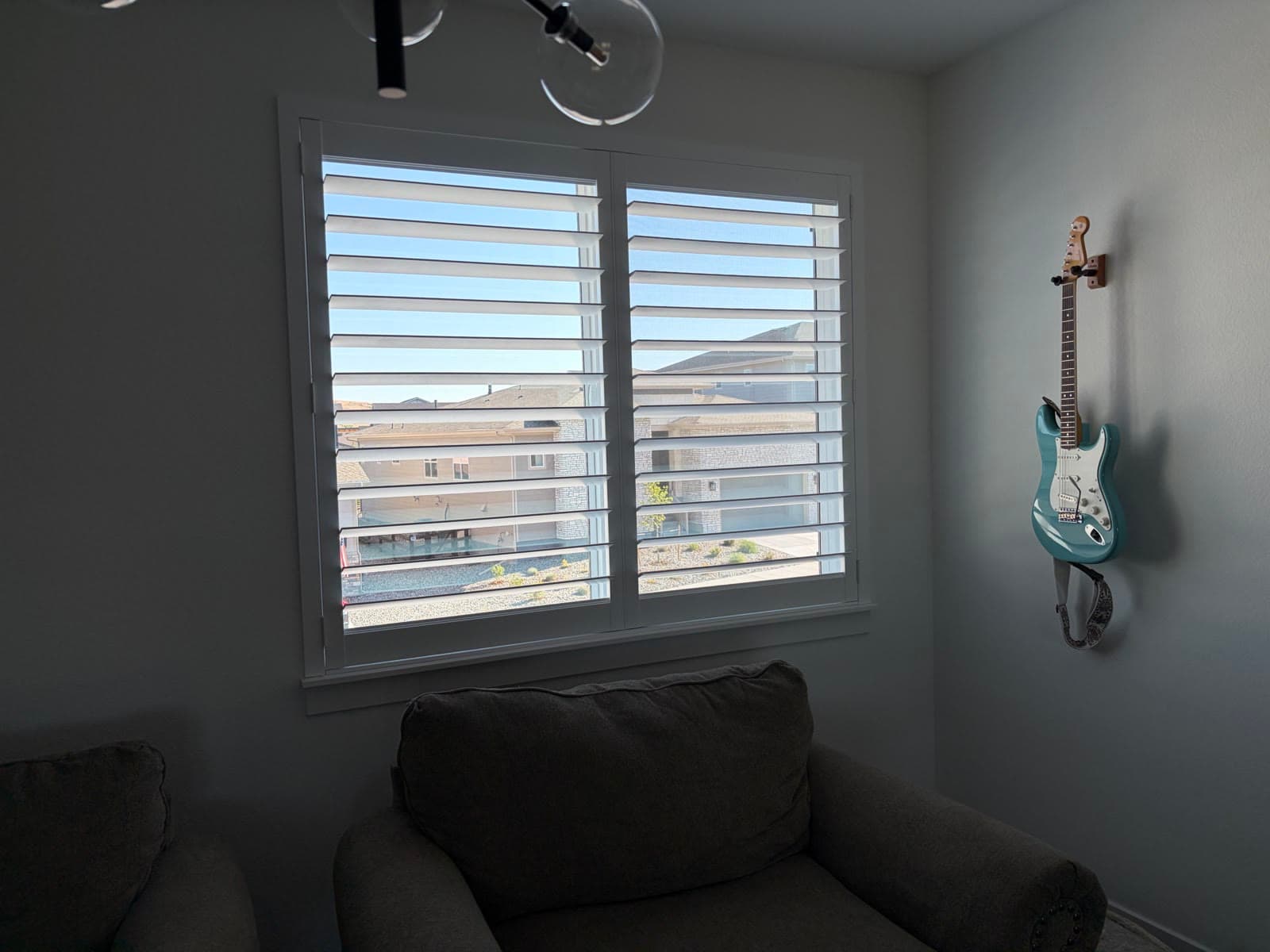
You closed the shutters, and the bedroom still glows at six in the morning. Thin lines of light run along every louver, and a bright seam shows where the two panels meet. Nothing is wrong with your shutters. That is simply how shutters work, and it is worth knowing before you order them for a room you want dark.
Here is the honest answer to whether plantation shutters block light, where the light gets in, and the setups we use when a room really needs to go dark.
Key Takeaways
- Plantation shutters block a lot of light when the louvers are closed, but they do not black out a room. Hunter Douglas says so plainly about its own shutters.
- Light gets in where the louvers meet, around the edges of each panel, and at the seam where two panels close together.
- For a dark bedroom or media room, pair the shutters with a room-darkening cellular shade, add drapery, or choose a darkening shade on its own for that window.
- A pairing only works if the window is deep enough for both, which is something we check when we measure.
Do plantation shutters block light?
Yes, a lot of it, but not all of it. With the louvers closed, shutters cut most of the daylight and give you full privacy. They are not a blackout product, though. Hunter Douglas, which makes every shutter we sell, states that shutters do not provide a complete blackout effect, even though closed louvers block a lot of light (Hunter Douglas, "Are Window Shutters Blackout?," retrieved 2026-10-01).
For a living room, a home office, or a dining room, that is usually exactly right. You get privacy, glare control, and a room that never feels closed in. The trouble only starts in the rooms where you want darkness on purpose, a primary bedroom, a nursery, or a room with a big screen.
Where the light gets in
A shutter is a hinged panel of wooden or composite slats inside a frame. Every place where two parts meet is a place light can pass. These are the usual suspects.
- Between the louvers. Closed louvers overlap, but they are rigid slats, not fabric. A thin line of light shows along each one, most of all when the sun hits the window directly.
- Around each panel. Panels need a small clearance from the frame so they can swing open and closed. That clearance is a gap, and light finds it.
- Where two panels meet. On a window with a pair of panels, the center seam is often the brightest line in the room.
- Around the frame itself. On an inside mount, the frame sits within the window opening. If the opening is not perfectly square, there can be small gaps at the edges.
None of this is a defect. It is the tradeoff that comes with a product built to tilt, swing open, and last for decades.
Louver size and light control
Louver size changes how a room feels with the shutters open more than how dark it gets with them closed. All three of the Hunter Douglas shutter lines we sell, Heritance hardwood, NewStyle hybrid, and Palm Beach polysatin, come with 2.5 inch, 3.5 inch, or 4.5 inch louvers (Hunter Douglas, Heritance, NewStyle, and Palm Beach product pages, retrieved 2026-10-01).
Larger louvers give you more view through the window when they are open and suit larger windows, while smaller louvers read more traditional and suit smaller windows (Hunter Douglas, "Why You Need Indoor Window Shutters," retrieved 2026-10-01). Smaller louvers also let you set the light in finer steps. Pick the size for the look and the view. Do not pick it expecting one size to make the room dark.
One more light control trick costs nothing. A shutter panel can be split with a divider rail so the top and bottom louvers tilt on their own. Close the bottom half for privacy and leave the top half open for daylight, which works well in bathrooms and street-facing bedrooms (Hunter Douglas, "Why You Need Indoor Window Shutters," retrieved 2026-10-01).
How to get a dark room with plantation shutters
If you love the look of shutters but need the room dark, you have four honest options.
1. Pair the shutters with a room-darkening cellular shade
This is the setup we recommend most often for a primary bedroom. A room-darkening cellular shade, also called a honeycomb shade, sits between the glass and the shutter. During the day, the shade stays up and out of sight, and the shutters do their normal job. At night, the shade comes down and handles the darkness, and the shutters close in front of it for the look.
Edges matter here too. Even opaque fabrics darken a room without removing every bit of light (Hunter Douglas, "Privacy and Light Control," retrieved 2026-10-01). Most of what gets past a good shade comes around its sides. Hunter Douglas built LightLock, offered only on Duette honeycomb shades, for exactly that problem. U-shaped side channels fit into the window and absorb the light that would otherwise slip around the edges (Hunter Douglas, "Privacy and Light Control," retrieved 2026-10-01). We installed motorized Duette with LightLock in a primary bedroom in The Canyons in Castle Pines, where the homeowners wanted a room dark enough to actually sleep in.
2. Add drapery over the shutters
Drapery panels on a rod above the window cover the light gaps at the sides and the top, and they soften a room at the same time. Hunter Douglas lists drapery as one of the ways to cover light gaps at a window (Hunter Douglas, "Privacy and Light Control," retrieved 2026-10-01). It is the simplest add-on, as long as the shutter panels still have room to swing open behind the fabric.
3. Mount the shutters outside the opening
An outside-mounted window treatment covers the whole window, so it blocks more light than one mounted inside the casing (Hunter Douglas, "Inside vs. Outside Mount," retrieved 2026-10-01). For shutters, an outside mount trades away some of that built-in look. It closes off the gaps around the frame, but the louvers and the center seam still let some light through.
4. Choose a darkening shade for that window instead
Sometimes the honest answer is that a particular window does not need a shutter at all. In a media room, or a bedroom where sleep is the only goal, a room-darkening cellular shade on its own may do the job better and keep the window simple. We would rather tell you that than sell you two products where one will do. Our room-darkening options cover the full range.
Making the shutter and shade pairing work
The pairing sounds simple, and it is, as long as the window cooperates. Three things decide whether it will.
- Window depth. The shade and the shutter both need room in the opening, and the louvers need space to tilt without hitting the shade. Some windows have plenty of depth. Others do not, and the shutter moves to an outside mount to make room.
- Handles and cranks. Window locks, handles, and casement cranks can get in the way of an inside mount (Hunter Douglas, "Inside vs. Outside Mount," retrieved 2026-10-01). We check for them when we measure.
- Reaching the shade. A shade tucked behind closed shutters is awkward to raise and lower by hand every day. Motorizing it solves that. With PowerView motorization, the shade can lower at bedtime and rise in the morning on a schedule you set once, so you never open the shutters to get to it.
Motorization reaches the shutters too. Palm Beach shutters are available with PowerView Automation, which tilts the louvers by remote, by app, or on a schedule (Hunter Douglas, "Shutters," retrieved 2026-10-01).
The best setups, room by room
| Room | What it needs | Setup we usually suggest |
|---|---|---|
| Primary bedroom | Darkness for sleep, privacy, a finished look | Shutters with a room-darkening cellular shade behind them, motorized if the shade is hard to reach |
| Nursery or kids' room | Darkness for naps, no cords | A cordless or motorized room-darkening cellular shade, with or without shutters in front |
| Media room | Little to no glare on the screen | A room-darkening cellular shade on its own, with side channels where the window allows |
| Street-facing bedroom | Privacy at night, light in the morning | Shutters with a divider rail, so the top half can open while the bottom stays closed |
| Living room, office, dining room | Privacy and glare control, not darkness | Shutters alone |
For a real example of mixing products by room, our Montaine project in Castle Rock used NewStyle shutters on the front of the house for privacy and motorized Duette honeycomb shades at the back for the views. One product for the whole house would have compromised both.
See the difference in person
Light leaks are easier to understand when you can see them. In our showroom at 735 Park Street in Castle Rock, you can close a shutter, look at the seams, and compare it with a room-darkening cellular shade side by side. We are the only Hunter Douglas showroom for interior window coverings in Castle Rock, and an authorized Hunter Douglas dealer since 2003.
Or book a free in-home consultation. In one appointment, we look at the actual windows, check the depth for a pairing, recommend a setup for each room, and give you a price on the spot. Our own salaried installers handle the install, not subcontractors. Every product carries a lifetime product warranty, plus free in-home service for 5 years.
The bottom line
Plantation shutters block a lot of light and give you full privacy, but they do not make a room dark. Light gets in between the louvers, around the panels, and at the center seam. If a room needs darkness, pair the shutters with a room-darkening cellular shade, add drapery, or let a darkening shade handle that window on its own. For the rest of the buying decisions, from materials to mounting, our plantation shutters buying guide walks through the full process.
Frequently asked questions
- Do plantation shutters block light completely?
- No. With the louvers closed, plantation shutters block a lot of light and give full privacy, but they do not black out a room. Light passes between the louvers, around the edges of each panel, and at the seam where two panels meet. Hunter Douglas states that its shutters do not provide a complete blackout effect.
- How do I make a room with plantation shutters dark?
- Pair the shutters with a room-darkening cellular shade mounted between the glass and the shutter, add drapery over the window to cover the gaps at the sides and top, or choose a room-darkening shade on its own for that window. For the darkest result with a cellular shade, side channels such as Hunter Douglas LightLock block the light that gets around the edges.
- Can you put a shade behind plantation shutters?
- Often, yes, as long as the window is deep enough for both and the louvers can tilt without touching the shade. If the opening is shallow, the shutter can be mounted outside the opening to make room. We check depth, handles, and cranks when we measure, so you know before you order.
- Do larger louvers let in more light?
- Larger louvers give a wider view and more daylight when the shutters are open, and they suit larger windows. Closed, any louver size still lets some light through at the seams, so louver size is a choice about the look and the view rather than about darkness.
- Are plantation shutters good for a bedroom?
- Yes, for privacy, glare control, and a finished look. If you need the bedroom dark for sleep, plan on pairing the shutters with a room-darkening cellular shade, and consider motorizing the shade so it lowers and rises on a schedule without you opening the shutters to reach it.
Sources
- Hunter Douglas, "Are Window Shutters Blackout?" (shutters do not provide a complete blackout effect; closed louvers block a lot of light) (retrieved 2026-10-01)
- Hunter Douglas, "Privacy and Light Control" (LightLock side channels, offered only on Duette; opaque fabrics darken but do not remove all light; drapery covers light gaps) (retrieved 2026-10-01)
- Hunter Douglas, "Inside vs. Outside Mount" (outside mount covers the whole window and blocks more light; handles and cranks affect inside mount) (retrieved 2026-10-01)
- Hunter Douglas, "Why You Need Indoor Window Shutters" (louver size and view; split panels for privacy and light) (retrieved 2026-10-01)
- Hunter Douglas, Heritance, NewStyle, and Palm Beach shutter product pages (louver sizes 2.5, 3.5, and 4.5 inch) (retrieved 2026-10-01)
- Hunter Douglas, "Shutters" (Palm Beach shutters with PowerView Automation) (retrieved 2026-10-01)
About the author
Lucas Campbell · Business Development, Value Blinds & Shutters
Lucas Campbell joined Value Blinds & Shutters full time in 2023 and works with homeowners across Castle Rock and the Front Range. Value Blinds is the only Hunter Douglas showroom for interior window coverings in Castle Rock and an authorized Hunter Douglas dealer since 2003.