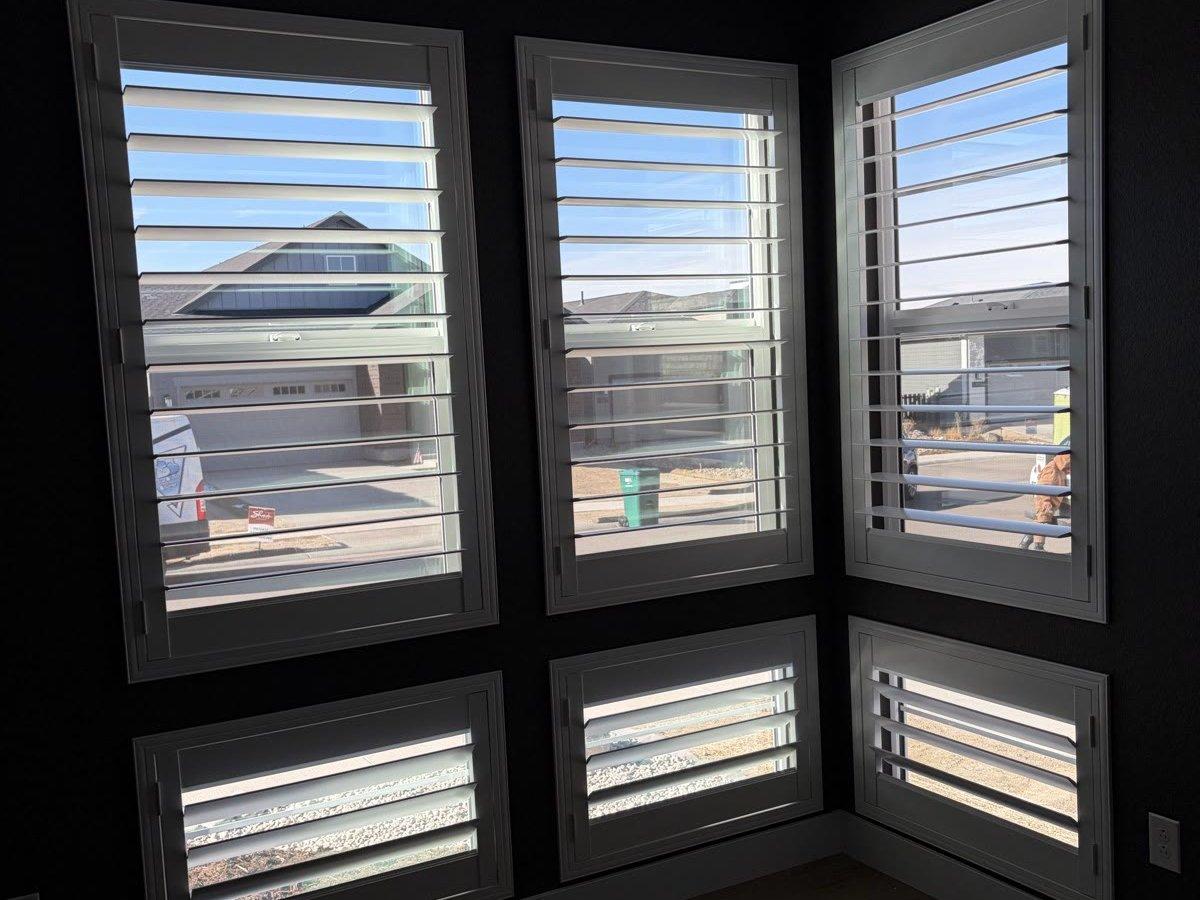
Neither one wins everywhere: real wood (Hunter Douglas Heritance) is better in dry rooms where you want rich grain, a stain, or a custom color, and composite (NewStyle) is better in busy rooms that take bumps from kids and pets. For bathrooms and windows that take hours of sun, polysatin vinyl (Palm Beach) beats both.
Most homes end up using two, or all three. In a Castle Rock or south Denver home, the right pick also depends on dry air and strong sun. We sell all three Hunter Douglas shutter lines and install them across the south Denver metro, which our plantation shutters in Denver page covers. Here's the honest breakdown of what each line is, how each handles Colorado conditions, and where each belongs, room by room.
Key Takeaways
- Real wood (Heritance) gives the richest grain, takes paint or stain, and has the widest color choice. It belongs in dry rooms like living rooms, dining rooms, studies, and most bedrooms.
- Composite (NewStyle) gives the look of painted wood with more durability, which suits busy family rooms, hallways, and homes with kids and pets.
- Polysatin (Palm Beach) is water resistant and UV resistant, with a written promise against warping, cracking, and fading. It's the pick for bathrooms, kitchen windows near the sink or stove, and the sunniest windows.
- Most homes should mix materials. The mistake is choosing one for the whole house instead of matching each room to what it actually needs.
Which is better, wood or composite plantation shutters?
Choose real wood when the room is dry and the finish will be on display, such as a living room, dining room, or study where the grain reads as furniture. Choose composite when the room sees daily wear and tear but stays dry. Choose polysatin when moisture, steam, or hours of direct sun are part of the room's daily reality.
Most homes end up using two or even all three.
How do wood, composite, and vinyl shutters compare?
Real wood is the lightest and has the most finish choices, composite is the tougher everyday option, and polysatin vinyl is the one built for water and sun. Here's how the three lines compare on what actually decides the choice. Treat it as a starting point; the right pick still changes room by room.
| What matters | Real wood (Heritance) | Composite / hybrid (NewStyle) | Polysatin vinyl (Palm Beach) |
|---|---|---|---|
| Material | 100% natural hardwood | Composite with a wood look | Polysatin vinyl compound |
| Weight | Lightest of the three | Heavier than real wood | Heavier than real wood; key parts reinforced with aluminum |
| Paint or stain | Painted or stained, plus custom paints and stains | Painted look only, low-luster Finetech finish | Whites only |
| Color choice | 20+ colors, plus custom | 8 colors | 3 whites |
| Moisture | Best in dry rooms (our recommendation) | Durable for daily wear; we keep it out of steam (our recommendation) | Water resistant, built for heat and humidity |
| Sun and UV | Best away from hours of direct sun | Best away from hours of direct sun | UV resistant, Palm Beach Promise against fading |
| Construction | Truemill dovetail | Truemill dovetail | Aluminum and resin block reinforcement |
| Louver sizes | 2.5", 3.5", 4.5" | 2.5", 3.5", 4.5" | 2.5", 3.5", 4.5" |
| Best rooms | Living, dining, studies, most bedrooms | Family rooms, hallways, kids' rooms | Bathrooms, laundry, kitchen sink and stove walls, sunrooms |
A few notes on the table. Industry guides describe composite and vinyl shutters as usually heavier than real wood, which matters most on large panels and wide windows (Norman, "Wood vs Wood Composite Shutters"; Blinds Chalet, "Pros and Cons of Faux Wood Shutters"). Real wood generally costs more than composite (Norman). Your actual price depends on the line, the size and number of windows, louver size, and configuration, and our are plantation shutters worth it guide walks through that math.
The "Sun" row for wood and composite is our recommendation, not a manufacturer limit. Palm Beach is the only one of the three lines with a written promise against fading. Hunter Douglas lists exposure to sun, and fading or discoloration over time, among the things its Lifetime Limited Warranty does not cover (Hunter Douglas, "What's Covered Under the Hunter Douglas Lifetime Limited Warranty?").
What does "composite" mean in the Hunter Douglas lineup?
In Hunter Douglas terms, composite means NewStyle, and vinyl means Palm Beach. In everyday shopping, "composite" gets used for any shutter that isn't solid wood. Hunter Douglas splits that group in two, and the difference matters for your rooms. It sells interior shutters in three materials: genuine hardwood as Heritance, composite as NewStyle, and vinyl as Palm Beach Polysatin (Hunter Douglas, "Shutters").
So when you compare wood and composite, you're really choosing among three lines. NewStyle is the composite. Palm Beach is the moisture specialist. Both are engineered to do things solid wood can't, but they solve different problems.
When is real wood Heritance the right choice?
Heritance is the right choice for dry rooms where the finish is seen up close. It's made from 100% natural hardwood, and it's the line with the most finish choices: more than 20 colors plus custom colors (Hunter Douglas, "Wood Shutters"). Custom paints and stains are an option, so you can match existing trim or cabinetry, or go the other way and make the shutters a statement. The panels use Truemill dovetail construction (Hunter Douglas, "Heritance Wood Shutters").
Where we place it: Hunter Douglas points humid areas such as bathrooms and kitchens to its Palm Beach Polysatin shutter (Hunter Douglas, "Why You Need Indoor Window Shutters"). We follow that lead. Our recommendation is to put Heritance in the dry rooms where its grain and finish are seen up close, and to use Palm Beach in full bathrooms and laundry rooms.
When is composite NewStyle the right choice?
NewStyle is the right choice for busy, dry rooms. It combines the look of genuine wood with the durability of composite materials, finished in a low-luster Finetech finish meant to read as finely painted wood (Hunter Douglas, "NewStyle Hybrid Shutters"). Hunter Douglas now calls the line NewStyle Hybrid Shutters and still lists it under composite shutters. It shares the Truemill dovetail construction and comes in 8 colors (Hunter Douglas, "Shutters").
Hunter Douglas describes composite shutters as extremely durable and suggests them for households with kids and pets that still want the look of hardwood (Hunter Douglas, "Shutters"). That makes NewStyle the practical choice for a busy family room, a hallway, or a mudroom-adjacent window that gets bumped. For steamy rooms, we steer people to Palm Beach instead, because that is the line Hunter Douglas points to for humid areas.
When is polysatin Palm Beach the right choice?
Palm Beach is the right choice wherever heat, humidity, or hours of sun are part of daily life. The polysatin compound is water resistant and UV resistant, and the Palm Beach Promise covers the shutters against warping, cracking, fading, chipping, peeling, and discoloring (Hunter Douglas, "Palm Beach Polysatin Vinyl Shutters"). Key parts, including the stiles, louvers, and T-posts, are reinforced with aluminum and molded resin blocks for stability (Hunter Douglas, "Palm Beach Polysatin Shutters Reference Guide," May 2025).
Color choice is narrower. Palm Beach comes in three whites: Bright White, White Silk, and White (Hunter Douglas, "Palm Beach Polysatin Vinyl Shutters"). Hunter Douglas also offers Palm Beach with PowerView motorization, so louvers can tilt on a schedule you set in an app (Hunter Douglas, "Shutters"). If that appeals, our PowerView motorization page explains how it works.
What about Colorado's dry air and strong sun?
Both point the same way: keep real wood in rooms with steady indoor conditions, and give the sunniest and steamiest windows polysatin. Two things set the Front Range apart from the coastal climates most shutter advice is written for, and here's what the sources say about each.
Dry air. The Western Regional Climate Center describes Colorado's humidity as generally quite low, and the plains east of the mountains as having a large daily range in temperature. Wood responds to that. Oregon State University Extension explains that dried wood still shrinks and swells as it loses or gains moisture, trading moisture with the surrounding air. It also notes that heating a home lowers indoor relative humidity (OSU Extension, "Wood Moisture Relationships").
Our read of those two sources together: real wood is happiest where indoor conditions stay fairly steady. A dry living room is fine. A bathroom that swings from dry winter air to shower steam several times a day is the hardest place for any natural wood finish, which fits Hunter Douglas pointing humid rooms to Palm Beach.
Strong sun. Castle Rock sits at 6,202 feet (Visit Castle Rock). The EPA notes that UV radiation increases about 2% for every 1,000 feet of elevation (EPA, "A Guide to the UV Index"). By that rule of thumb, a Castle Rock window sees roughly 12% more UV than the same window at sea level. For the south- and west-facing windows that take sun for hours, Palm Beach is the line with a written promise against fading.
What to ask at your consultation. Ask which of your windows take direct sun for most of the day, and which rooms swing between dry air and steam. Those two answers settle most material choices. Bring both up when we measure, and we will factor them into the recommendation for each window.
Which shutter material do most of our customers choose?
Most choose NewStyle composite. Lucas Campbell works with homeowners across Castle Rock and the Front Range. He says 90% of our customers go with NewStyle because it feels like wood and, in white, looks like wood. It also costs less and holds up to the dry air better than wood shutters.
Real wood still has its place. Lucas says wood holds up extremely well when it's stained. With painted wood, he says, the small expanding and contracting caused by changes in humidity and temperature can make the paint chip over about 20 years.
Real wood still works in a dry room; it just isn't the only choice there. If you want real wood, Lucas's experience points to a stain over paint. Mixing still makes sense when a room calls for it, such as Palm Beach in a steamy bathroom or on a window that takes hours of sun.
Which shutter material goes in which room?
Put polysatin where there's steam or hours of sun, composite where the room takes a beating, and real wood where the finish is on display. Here's how that plays out room by room.
Bathrooms and laundry rooms
Polysatin. Hunter Douglas says the bathroom is often the most humid room in the home and recommends Palm Beach for it, especially when the window is near the shower (Hunter Douglas, "Bathroom Window Treatment Ideas"). If you want light from above and privacy below, shutters can go on just the lower part of the window. We extend the same choice to laundry rooms; that part is our recommendation.
Kitchens
It depends on where the window sits. Near the sink, stove, or prep areas, water, steam, and grease can reach the window. There, Hunter Douglas points to polysatin because it wipes clean with a damp cloth, and it notes Palm Beach is more resilient to stains than hardwood (Hunter Douglas, "The Top 5 Kitchen Window Treatments"). A kitchen window well away from the cooking can take wood or composite to match the rest of the main floor.
Living rooms, dining rooms, and studies
Real wood. Hunter Douglas names living rooms and home offices as terrific rooms for real wood shutters (Hunter Douglas, "Shutters"). These are dry rooms where the finish is seen up close, and Heritance's stain and custom paint options let the shutters match built-ins, floors, or trim.
Bedrooms
Either wood or composite works, so the choice usually comes down to finish and how you like the light. If a bedroom needs to be truly dark, see our room darkening options.
Kids' rooms and playrooms
Composite earns its place here. It handles bumps and fingerprints, and Hunter Douglas suggests composite for homes with kids and pets (Hunter Douglas, "Shutters"). Shutters also help with safety. Palm Beach louvers, for example, tilt with a tilt bar or an internal gear, not a lift cord (Hunter Douglas, "Palm Beach Polysatin Shutters Reference Guide," May 2025). The Consumer Product Safety Commission advises choosing cordless window coverings in all rooms where a young child may be present. Our child safety page covers the rest of the house.
Sunrooms and west-facing windows
Polysatin. This is where Colorado's altitude matters most, and where the Palm Beach Promise against fading does its work. If a sunroom has arches or angled windows, Palm Beach comes in specialty shapes; note that Hunter Douglas doesn't offer its specialty shapes with PowerView motorization or SoftClose soft-closing louvers (Hunter Douglas, "Palm Beach Polysatin Shutters Reference Guide," May 2025). Our specialty shapes page shows what's possible.
Do louver and panel sizes differ by material?
Louver sizes don't: all three lines come in 2.5, 3.5, and 4.5 inch louvers (Hunter Douglas, "Heritance Wood Shutters," "NewStyle Hybrid Shutters," and "Palm Beach Polysatin Vinyl Shutters"). As a rule of thumb, Hunter Douglas says smaller louvers are often better for smaller windows and look more traditional, while larger louvers work best for larger windows and give a greater view-through and a sleek appearance (Hunter Douglas, "Why You Need Indoor Window Shutters").
Panel size has limits, too. For Palm Beach, a standard hinged panel can be up to 36 inches wide and 120 inches tall. Panels taller than 66 inches need a divider rail, and Hunter Douglas doesn't recommend panels under 12 inches wide (Hunter Douglas, "Palm Beach Polysatin Shutters Reference Guide," May 2025). We check every opening against the spec for the line you choose when we measure. Mounting matters as much as material, and our inside vs outside mount shutters guide explains frames and panel layouts. Our plantation shutters buying guide covers the rest of the process.
How do you clean each shutter material?
Light, regular dusting does most of the work for all three, but the details differ a little.
- Heritance (wood): dust regularly, vacuum with a brush attachment, and spot-clean with a soft cloth or sponge barely moistened with lukewarm water and mild detergent if needed (Hunter Douglas, "How to Clean Heritance Hardwood Shutters").
- NewStyle (composite): dust or vacuum with a brush attachment, and wipe with a dryer sheet to cut static. Skip abrasive cleaners and chemical solvents, which can scratch the surface (Hunter Douglas, "How to Clean NewStyle Hybrid Shutters").
- Palm Beach (polysatin): dust with a feather duster or microfiber cloth, use a dryer sheet to repel dust, and avoid abrasive cleaners and solvents (Hunter Douglas, "How to Clean Palm Beach Polysatin Vinyl Shutters"). Near a stove, the damp-cloth wipe-down is what makes it practical.
How do you decide which material each room needs?
Ask three questions about each room, in this order.
- Does this room get steam or splashes? If yes, polysatin.
- Does the window take hours of direct south or west sun? If yes, polysatin is the safest bet, with its promise against fading.
- Is the finish on display, or does the room take a beating? On display, real wood. Taking a beating, composite.
Walk through the house with those three questions and you'll usually land on a clear answer for every window. Hunter Douglas runs coordination programs that match Palm Beach colors with Heritance and NewStyle, so the house still looks intentional when the materials change (Hunter Douglas, "Palm Beach Polysatin Shutters Reference Guide," May 2025).
Where can you see all three side by side?
In our Castle Rock showroom, where you can see and feel Heritance, NewStyle, and Palm Beach together. Photos and a table only go so far, so the fastest way to decide is to compare them in person, then talk through your actual rooms. We're the only Hunter Douglas showroom for interior window coverings in Castle Rock, and an authorized Hunter Douglas dealer since 2003. What shutters cost depends on the line, the size and number of windows, louver size, and the configuration you choose, so there's no flat price that fits every home. In one appointment, we measure your windows, walk through material and mounting, and give you a price on the spot. Every shutter we sell carries a lifetime product warranty plus free in-home service for 5 years.
Come by the showroom at 735 Park Street, Unit L, or book a free in-home consultation and we'll bring samples to you. If you live north of Castle Rock, our plantation shutters in Denver page shows the communities we install in. For faux wood and plain vinyl as well, our shutter materials guide rounds out the picture, and our custom shutters page shows the full lineup.
Frequently asked questions
- Which material is best for plantation shutters?
- There is no single best material; it depends on the room. Real wood, like Hunter Douglas Heritance, is best in dry rooms where the finish is on display. Composite, like NewStyle, is best in busy rooms that take bumps. Polysatin vinyl, like Palm Beach, is best in bathrooms, near the kitchen sink or stove, and in windows that take hours of sun.
- Do faux wood shutters cost less than real wood?
- Usually, yes. Faux wood and composite shutters generally cost less than real hardwood, and real wood sits at the top of the price range. Your actual price depends on the line, window size and count, louver size, and configuration, so we price it in one in-home appointment.
- Are plantation shutters more expensive than blinds?
- Yes. Plantation shutters cost more upfront than blinds, and usually more than shades. Whether that's worth it depends on how long you'll own the home and which rooms you're covering. We measure your actual windows and give you an honest, itemized price on the spot, so you can compare shutters against blinds room by room.
- Are composite shutters as good as real wood?
- For the right room, yes. Composite shutters like Hunter Douglas NewStyle combine the look of genuine wood with the durability of composite materials, which suits busy family rooms and homes with kids and pets. Real wood, Hunter Douglas Heritance, offers the richest grain and the widest color choice and is best in dry rooms. Neither is a downgrade from the other; they solve different problems.
- Is Palm Beach a composite shutter?
- Not in Hunter Douglas's own terms. Hunter Douglas classes Palm Beach as a polysatin vinyl shutter and NewStyle as its composite shutter. People often use "composite" for any shutter that isn't solid wood, so it helps to ask which line you're actually being shown.
- Which shutter material is best for a bathroom?
- Polysatin. Hunter Douglas Palm Beach shutters are water resistant and built for heat and humidity, backed by the Palm Beach Promise against warping, cracking, fading, chipping, peeling, and discoloring. Hunter Douglas points humid rooms such as bathrooms to Palm Beach, and we follow that lead by keeping Heritance real wood in drier rooms.
- Are wood shutters covered against sun fading?
- No. Hunter Douglas makes no written no-fade promise for Heritance real wood shutters, and its Lifetime Limited Warranty lists exposure to sun, and fading or discoloration over time, among the things it does not cover. The written promise against fading belongs to Palm Beach polysatin shutters, which are UV resistant and covered by the Palm Beach Promise. UV also climbs with elevation, about 2% per 1,000 feet according to the EPA, and Castle Rock sits above 6,000 feet. For south- and west-facing windows that take hours of direct sun, we recommend Palm Beach and keep real wood for rooms with gentler light.
- Do real wood shutters work in Colorado's dry climate?
- Yes, in the right rooms. Wood shrinks and swells a little as indoor humidity changes, and winter heating makes indoor air drier. Real wood does best where conditions stay fairly steady, such as living rooms, dining rooms, and studies. The room to avoid is one that swings between dry air and shower steam every day.
- How do I clean wood, composite, and polysatin shutters?
- Regular light dusting does most of the work for all three. For Heritance wood, vacuum with a brush attachment and spot-clean with a soft cloth barely moistened with lukewarm water. For NewStyle and Palm Beach, a dryer sheet helps repel dust; avoid abrasive cleaners and chemical solvents, which can scratch the surface.
- Can I mix wood and composite shutters in the same house?
- Yes, and most homes should. Living rooms, dining rooms, and studies typically suit real wood, family rooms and kids' rooms suit composite, and bathrooms, kitchen sink walls, and high-sun windows suit polysatin. Hunter Douglas coordinates colors across the three lines, and we plan the mix room by room in one in-home appointment.
Sources
- Hunter Douglas, "Shutters" (Heritance wood, NewStyle composite, and Palm Beach vinyl lines; color counts; PowerView on Palm Beach; FAQ on composite vs real wood) (retrieved 2026-10-08)
- Hunter Douglas, "Heritance Wood Shutters" and "Wood Shutters" (100% natural hardwood, Truemill dovetail, louver sizes, custom paints and stains, 20+ colors) (retrieved 2026-10-08)
- Hunter Douglas, "Heritance Wood Shutters" product page (painted and stained finishes, custom paints and stains) (retrieved 2026-11-09)
- Hunter Douglas, "NewStyle Hybrid Shutters" (composite durability, Finetech finish, louver sizes, 8 colors) (retrieved 2026-10-08)
- Hunter Douglas, "NewStyle Composite Shutters" product page (look of finely painted wood, Finetech finish) (retrieved 2026-11-09)
- Hunter Douglas, "What's Covered Under the Hunter Douglas Lifetime Limited Warranty?" (exclusions for sun exposure and fading) (retrieved 2026-10-09)
- Hunter Douglas, "Palm Beach Polysatin Vinyl Shutters" (water and UV resistance, Palm Beach Promise, louver sizes, three colors) (retrieved 2026-10-08)
- Hunter Douglas, "Palm Beach Polysatin Shutters Reference Guide" (May 2025; reinforcement, panel size limits, specialty shapes, tilt mechanisms, color coordination) (retrieved 2026-10-08)
- Hunter Douglas, "Why You Need Indoor Window Shutters" (louver size guidance; Palm Beach Polysatin for humid areas) (retrieved 2026-10-09)
- Hunter Douglas, "Bathroom Window Treatment Ideas" and "The Top 5 Kitchen Window Treatments" (retrieved 2026-10-08)
- Hunter Douglas, care pages for Heritance, NewStyle, and Palm Beach shutters (retrieved 2026-10-08)
- Norman, "Wood vs Wood Composite Shutters: Which Is Better?" (June 2023; composite shutters usually heavier than wood; wood generally costs more than composite) (retrieved 2026-11-09)
- Blinds Chalet, "Pros and Cons of Faux Wood Shutters" (faux wood heavier than natural wood; weight a consideration for large windows) (retrieved 2026-11-09)
- Western Regional Climate Center, "Climate of Colorado" (retrieved 2026-10-08)
- Oregon State University Extension, "Wood Moisture Relationships" (EM 8600) (retrieved 2026-10-08)
- U.S. EPA, "A Guide to the UV Index" (retrieved 2026-10-08)
- Visit Castle Rock, "About Castle Rock" (elevation 6,202 feet) (retrieved 2026-10-08)
- U.S. CPSC, "The Safest Window Coverings When Young Children Are Present Are Cordless" (retrieved 2026-10-08)
- Lucas Campbell, Value Blinds & Shutters (retrieved 2026-11-09)
About the author
Lucas Campbell · Business Development, Value Blinds & Shutters
Lucas Campbell joined Value Blinds & Shutters full time in 2023 and works with homeowners across Castle Rock and the Front Range. Value Blinds is the only Hunter Douglas showroom for interior window coverings in Castle Rock and an authorized Hunter Douglas dealer since 2003.