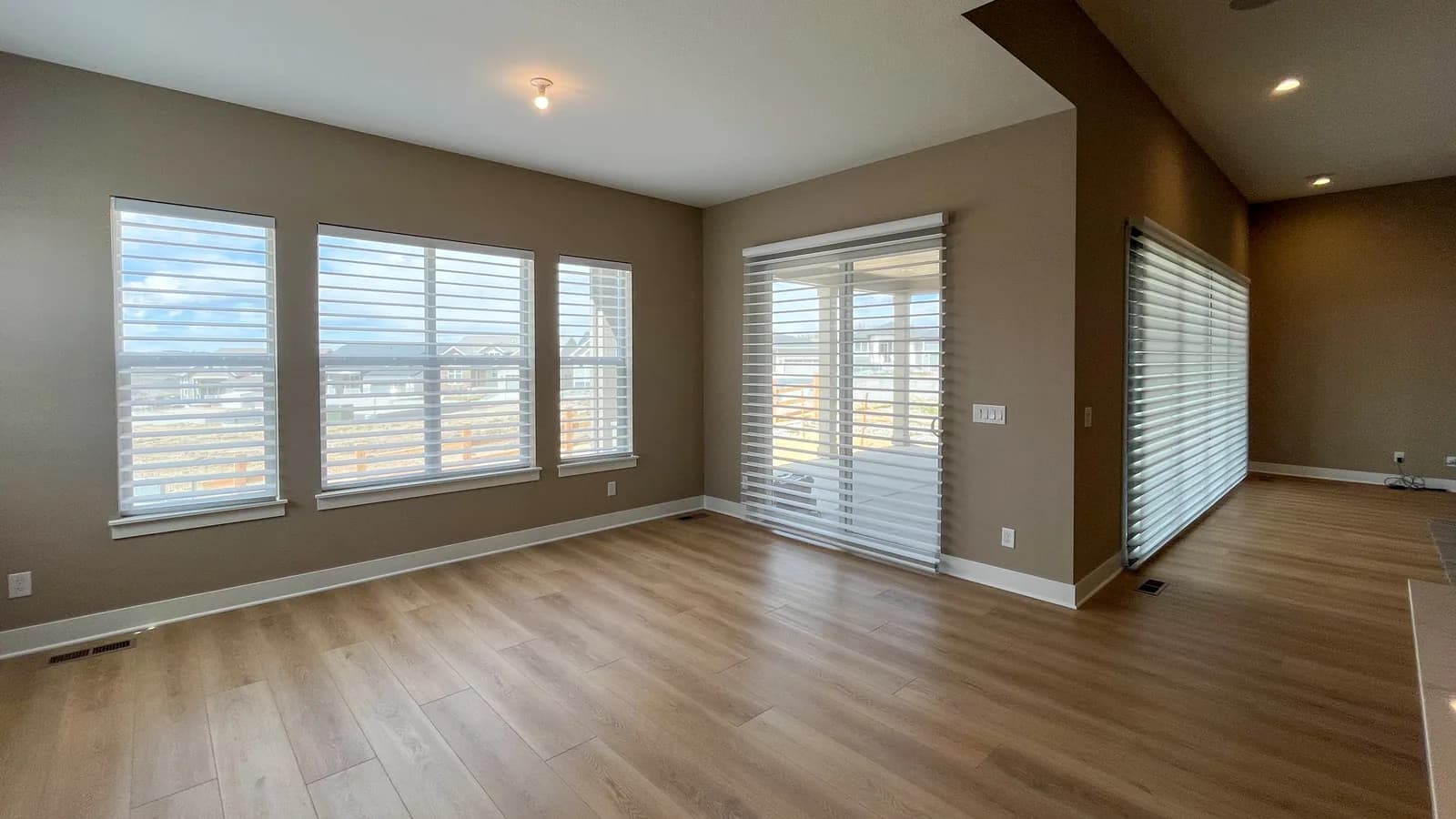
A new build is the one moment when motorized shades are easy to get exactly right. The walls are open, the wiring is reachable, and nothing has been closed up yet.
Wait too long, though, and the easy options quietly disappear. This guide covers why the decision belongs before drywall, what a hardwired setup changes, and how to plan openings so your shades look built-in, not added on. For the full picture, start with our motorized window coverings.
Key Takeaways
- A regret we hear often on new-build jobs is deciding on window coverings too late, after the walls are closed and the easy options are gone.
- Choosing motorized shades before drywall lets you hardwire them for steady power, with no batteries to recharge and no visible cords.
- It also lets you frame openings for a clean, recessed fit instead of working around finished walls later.
- One pre-drywall planning appointment sets the wiring, sizing, and recess before anything closes up.
Why decide on motorized shades before drywall?
Because the easiest, best-looking version of the job only exists while the walls are open. A regret we hear often on new-build jobs is deciding on window coverings too late. Once drywall goes up, hardwiring means cutting into finished walls, and the clean recessed fit gets harder to build.
Deciding early keeps every option on the table. You can run steady low-voltage power to each window, so a shade never needs a battery. You can size the opening for a recessed shade. And you can hide the pocket in the ceiling or header before it's framed.
What we see on new-build jobs: the homeowners who call us during framing rarely compromise on anything. The ones who call after paint are the ones choosing between "cut the wall" or "settle for batteries." Both work, but only one was ever the plan.
Timing is the whole message here. Everything else in this guide is easier when you handle window coverings before drywall.
What does the new-build motorization timeline look like?
Here's the honest version of how it sequences. On our new-build jobs the lesson is always the same: plan the motor and its power path early, because retrofitting later is the hard road. Hunter Douglas builds PowerView shades to run on either a battery or a hardwired power source, so the choice is worth making before the walls close (Hunter Douglas, PowerView Gen 3 Support, retrieved 2026-07-22). The stages below keep the decision ahead of the drywall.
| Stage | When it happens | What gets done |
|---|---|---|
| Plan | Before drywall | Choose motorized shades, mark each window, decide hardwired vs. battery |
| Rough-in | Electrical stage | Run low-voltage power to each opening; frame the recess and any pockets |
| Close up | Drywall and finish | Walls close with openings sized and wired for a clean fit |
| Install | Near move-in | Final measure, install, connect power, program schedules |
The key is that the "Plan" stage has to land before the electrician is done. That's the deadline that matters. Miss it, and hardwiring turns into a remodeling task instead of a wiring task.
On our new-build projects, the planning appointment usually takes one visit. We walk the framed rooms, mark the windows, and hand your electrician a simple list of where power needs to land.
What changes when you hardwire motorized shades?
Steady power changes the whole ownership experience. Hunter Douglas PowerView shades can run on rechargeable batteries or on a hardwired power source, and the hardwired option removes the recharge cycle entirely (Hunter Douglas, PowerView Gen 3 Support, retrieved 2026-07-22). For tall or hard-to-reach windows, that difference is the whole point.
A hardwired shade never slows down or stalls because a battery ran low. There's no ladder, no charging cable, no wondering when the next recharge is due. The power is just always there, quietly, behind the wall.
You also lose the visible cords. When power comes from inside the framing, nothing dangles down the wall to an outlet. That's the built-in look people picture when they imagine motorized shades in a finished room.
When homeowners tell us they want their shades to "just disappear into the house," hardwiring is usually what they're describing without the technical word for it.
Batteries are still a fine choice for many rooms, and we'll say so honestly. But a new build is the rare chance to skip them without opening a wall. If you're weighing the upgrade at all, our guide on whether are motorized shades worth it works through the math.
How do you plan openings, recess, and pockets?
You size the opening for the shade instead of forcing the shade to fit the opening. Hunter Douglas documents mounting and clearance requirements for its PowerView systems, and those details are far easier to build in during framing than to retrofit (Hunter Douglas, PowerView Gen 3 Support, retrieved 2026-07-22). Get the opening right, and the shade sits clean and square.
Three things are worth planning while the walls are open:
- Recess depth. A recessed shade tucks into the window opening for a tidy, inside-mount look. That depth is set during framing, not after.
- Ceiling or header pockets. A pocket hides the headrail so the shade seems to vanish into the ceiling. It has to be framed before drywall.
- Wiring runs. Low-voltage power should reach each opening before the walls close, so the shade never needs a battery.
Custom-sized shades matter most on the big windows. Great rooms, stairwell windows, and tall glass are exactly where a proper fit and a hardwired motor pay off, and where reaching a manual shade is a daily annoyance. Our guide to the best rooms for motorized shades breaks that down room by room.
How do you loop in your builder or designer?
Early, and with a short, clear scope. In our experience, new-build motor and power planning goes smoothly when the covering decision is coordinated with the trades before rough-in, not squeezed in afterward. Your builder mainly needs two things from us: where power lands, and how each opening gets framed.
We're used to working alongside builders and designers, and we keep it simple for the crew. After the planning visit, your electrician gets the power locations and your framer gets the recess and pocket details. No guesswork, no back-and-forth.
If you're a builder or designer reading this, that coordination is the whole relationship. We show up on schedule, our own installers do the work, and the warranty follows the home to your client. It's the kind of partnership that repeats across projects.
For homeowners, you don't have to manage any of that. We speak the trades' language so you don't have to translate it.
Book a pre-drywall planning consult
If your home is framed or heading there soon, this is the moment to plan. Book a pre-drywall planning consult and we'll walk the space, mark the windows, and hand your builder the wiring and framing details. One appointment, no pressure, and an honest recommendation on what actually earns the hardwired upgrade.
You can see PowerView move in person first. We're the only Hunter Douglas showroom for interior window coverings in Castle Rock, an authorized Hunter Douglas dealer since 2003, at 735 Park Street. Book a free in-home consultation.
The bottom line
A new build gives you one clean shot at motorized shades that look and work like they were always part of the house. Decide before drywall, and you can hardwire for steady power, skip the batteries, hide the cords, and size every opening for a built-in fit.
Wait, and those choices get more expensive and more compromised. The fix later is a wall to open, not a wire to run. That's why the planning appointment belongs during framing, not after paint.
For the full guide to choosing and living with motorized shades, start with our motorized window coverings.
Frequently asked questions
- When should I decide on motorized shades in a new build?
- Before drywall, and ideally before your electrician finishes rough-in. That timing lets you hardwire the shades for steady power and frame each opening for a clean, recessed fit. A regret we hear often is deciding too late, because retrofitting then means cutting into finished walls.
- Do motorized shades have to be hardwired in new construction?
- No. Hunter Douglas PowerView shades run on rechargeable batteries or a hardwired power source. Batteries are a solid choice for many rooms. A new build is simply the rare chance to hardwire without opening a wall, which removes recharging and hides every cord for a built-in look.
- What do I need to tell my builder or electrician?
- Two things: where low-voltage power should land at each window, and how each opening should be framed for recess or a ceiling pocket. After a single planning visit, we hand your trades a clear list, so nothing gets guessed at or missed before the walls close up.
- Are hardwired motorized shades covered by a warranty?
- Yes. Every product we install carries a lifetime product warranty, plus free in-home service for the first 5 years, meaning parts, labor, and trip charge included. After 5 years, a small trip charge applies while the lifetime product warranty continues to cover the product itself.
Sources
- Hunter Douglas, "PowerView Gen 3 Support" (retrieved 2026-07-22)
About the author
Lucas Campbell · Business Development, Value Blinds & Shutters
Lucas Campbell joined Value Blinds & Shutters full time in 2023 and works with homeowners across Castle Rock and the Front Range. Value Blinds is the only Hunter Douglas showroom for interior window coverings in Castle Rock and an authorized Hunter Douglas dealer since 2003.