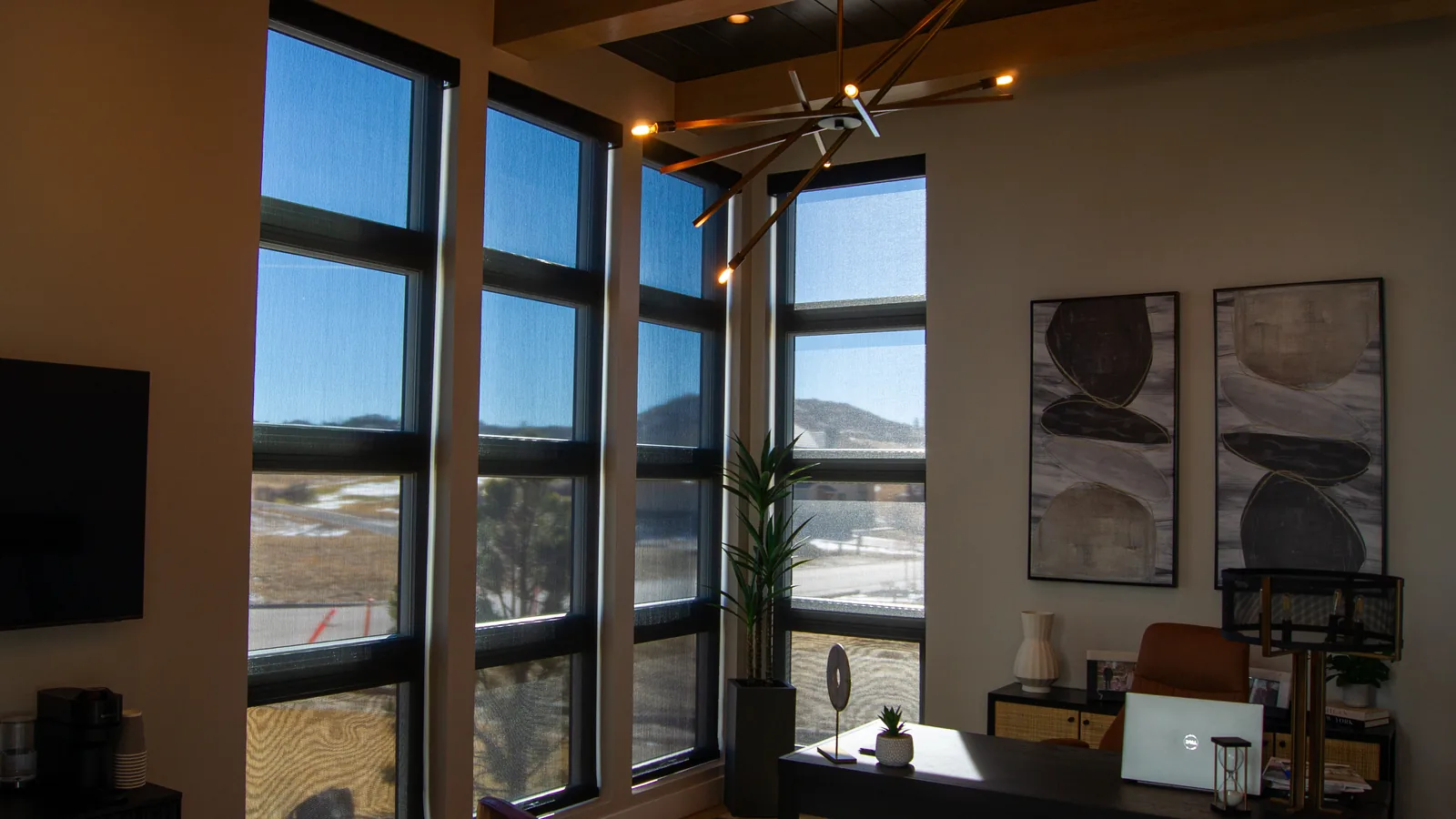
Motorized shades do one quiet thing well. They take a daily chore off your list, then keep doing it for years.
Tap a button, set a schedule, or say a word, and your windows handle themselves. No cords, no reaching behind furniture, no fighting a wall of tall windows every morning.
This guide covers what motorized window coverings are, how Hunter Douglas PowerView works, what you can automate, what it costs, and what happens when something needs attention. We sell and install these systems every day, so we'll keep it plain and honest.
We're the only Hunter Douglas showroom for interior window coverings in Castle Rock, and an authorized Hunter Douglas dealer since 2003. Think of this as your map to the whole topic, with links to deeper guides on each decision. Not sure it's for you yet? Start with are motorized shades worth it.
Key Takeaways
- Motorized shades automate light, privacy, and sleep on a schedule, so you rarely touch a window again.
- The real gap between premium and entry-level kits is quiet operation, custom fit, smart-home integration, and who fixes it later.
- Cost depends on window size, fabric, and system, so we give you an honest, itemized price in one in-home appointment.
- We install with our own salaried team and back every job with a lifetime product warranty plus free in-home service for 5 years.
What are motorized window coverings?
Motorized window coverings are blinds and shades with a small motor built into the headrail, so they raise, lower, or tilt on command instead of by hand. You control them with an app, a remote, a schedule, or your voice. Hunter Douglas PowerView is the interior line we install, and its motors run on a rechargeable battery or a hardwired connection.
The category is broad. "Motorized blinds" usually means horizontal slats you can tilt. "Motorized shades" and "motorized roller shades" mean a fabric that rolls or stacks up and down.
Under one umbrella, motorized window coverings include roller and solar shades, cellular (honeycomb) shades, Roman shades, wood and faux-wood blinds, and drapery. The motor and controls are similar. The fabric or slat is what changes with the room.
One misconception worth clearing up early. Motorized does not automatically mean "smart." A basic motor with a remote is motorized. A system that follows schedules, the sun, and your voice is where the real convenience lives, and that's what PowerView is built for.
How does Hunter Douglas PowerView work?
PowerView works by putting a quiet motor in each shade and connecting it to a small hub, called a gateway, that links to your home Wi-Fi and the PowerView app. The current Gen 3 system runs near-silent motors and adds Matter support, so it can join a wider range of smart homes (Hunter Douglas, PowerView Gen 3 Support, 2026).
The flow is simple once it's set up:
- The shade holds a motor and a rechargeable battery, or a hardwired power line in new construction.
- The gateway talks to every shade over a low-power wireless signal, then bridges them to your network.
- The app, a remote, or your voice sends the command, and the gateway relays it.
Placement matters more than most people expect. When the gateway sits close to the shades, with fewer walls in the way, signals land reliably. A careful installer plans that placement on the first visit, which prevents the most common headaches down the road.
Gen 3 also folded the old separate bridge into the gateway and improved the wireless layer. In plain terms, the newest version is designed to be steadier and quieter than the systems some early adopters remember.
What can you automate with motorized shades?
You can automate four things: schedules, sun position, remote app control, and voice. Together they mean your shades open with the morning, close against afternoon glare, and lower at night without you lifting a finger. Owners who set this up describe living with shades they simply stop thinking about (AppleInsider, 2021).
Here is what each control actually does for you.
| Automation | What it does | Everyday example |
|---|---|---|
| Schedules | Shades move at set times | Bedroom opens at 6:45 a.m. to wake with the light |
| Sun and season | Positions tuned to time of day | West windows lower before the afternoon glare hits |
| App control | Run any shade from your phone | Close the whole great room from the couch or the airport |
| Voice and scenes | One word moves a group | "Good night" lowers every shade in the house |
Scenes are the quiet favorite. Instead of moving shades one by one, you group them, "Living Room," "Morning," "Movie Night," and trigger the whole set at once.
Automation is also a safety win. There are no cords or chains, which matters in homes with kids or pets. And shades that move on their own protect floors and furniture from sun fade during the hours you're not home.
What do motorized shades cost, and are they worth it?
Motorized shades cost more than manual ones, and whether they're worth it depends on the room and how you live. There's no one price, because cost swings with window size, fabric, the number of openings, and the system you choose. Rather than quote you a guess, we give you an honest, itemized number in a single in-home appointment.
The honest way to think about price is total cost of ownership, not the sticker. A quality shade that fits perfectly, runs quietly, and gets serviced when needed can outlast two or three lesser replacements. That's the math behind buying it once.
Motorization tends to be worth it when:
- Windows are tall, wide, or hard to reach.
- A room needs light or privacy on a reliable daily schedule.
- Sleep, glare, or sun fade is a real, recurring problem.
It's often not worth it in a spare room nobody uses, or a small window you happily adjust by hand. We'll tell you that in your home, plainly, rather than motorize every opening.
For a full breakdown of the payback, room by room, see are motorized shades worth it.
PowerView vs. entry-level kits: what's the real difference?
The real difference isn't whether a shade moves, it's how it moves and who stands behind it. Entry-level kits like SmartWings, SwitchBot, and IKEA work fine for some jobs. The premium case rests on quiet operation, custom fit, integration, and service. In our experience, entry-level motors can drift out of sync over time, leaving an uneven line across a wall of windows, while premium motors hold their line.
Battery life is another quiet divider. Premium motors run quieter and hold a charge longer, often for years between charges, where lesser motors can need topping up far more often. Across a whole house, that difference is the gap between "set it and forget it" and a recurring chore.
| What matters | DIY entry-level kits | Hunter Douglas PowerView |
|---|---|---|
| Fit | Off-the-shelf or self-measured sizes | Measured and made for each window |
| Noise | Often louder, more noticeable | Near-silent Gen 3 motors |
| Alignment | Motors can drift out of sync | Shades line up across a wall |
| Install | You do it | Our salaried installers |
| After the sale | You troubleshoot online | Local warranty and in-home service |
None of this means entry-level kits are bad. It means they solve a different problem for a different buyer. For a fuller, honest comparison with the numbers, read powerview vs entry-level kits.
What happens if a motorized shade stops working?
Most problems are fixable, and most trace back to setup, not the shade itself. The common symptoms are a shade that stops responding, one that moves on its own, or one that goes quiet after months of good behavior. Hunter Douglas documents the same troubleshooting path, and it usually points to the hub, the network, or a battery (Hunter Douglas, PowerView Gen 3 Support, 2026).
That's exactly why who installs your system matters. When the gateway is placed well and the schedules are programmed correctly the first time, the two most common failure points rarely happen at all.
And when a shade does need attention, it should be a phone call, not a lost weekend. That's what a local dealer with its own service team provides. For the full reliability story, and what our promise covers, see what happens when a motorized shade stops working.
Does PowerView work with your smart home?
Yes. PowerView works with Apple Home and Siri, Amazon Alexa, and Google Home, and the Gen 3 gateway adds Matter, the newer standard that helps devices from different brands work together (Hunter Douglas, PowerView Gen 3 Support, 2026). That means you can fold your shades into the same routines that run your lights, thermostat, and locks.
A few plain-language notes on how it fits together:
- Voice lets you say "close the shades" through your assistant of choice.
- Routines let shades join a scene, so "Good Night" can dim lights and lower shades together.
- The app remains the hub for schedules, groups, and fine adjustments.
The app has a mixed reputation, and we won't pretend otherwise. The setup and configuration are where a careful installer earns their keep, getting the gateway, network, and integrations working together so it just responds. For the full compatibility rundown, see does powerview work with homekit.
Planning motorized shades for a new build
The single biggest new-build mistake is deciding too late. If you choose motorization before the drywall goes up, the wiring can be run for steady, hardwired power, with no batteries to recharge and no visible cords anywhere (Hunter Douglas, PowerView Gen 3 Support, 2026). Deciding early also lets openings get sized and recessed correctly.
Waiting until move-in still works, and battery-powered shades are a genuinely good option. But a pre-drywall plan buys a cleaner result: hidden power, tidy pockets for the shades to tuck into, and windows framed with motorization in mind.
The timing is short and easy to miss during a busy build. We can plan it around your construction schedule in a single appointment, and coordinate with your builder or designer. For the full pre-drywall playbook, read motorizing your new build.
Which rooms are best for motorized shades?
The best rooms for motorized shades are the ones where reaching, timing, or sleeping is a daily struggle. Bedrooms top the list, where blackout shades on a schedule protect sleep and wake you with the light. Great rooms with tall or hard-to-reach windows come next, since those are the shades nobody wants to work by hand.
Where motorization tends to pay off most:
- Bedrooms: blackout fabric plus a schedule for real sleep.
- Great rooms and tall windows: shades you could never reach comfortably.
- Bright, view-facing rooms: solar shades that cut glare and block UV while keeping the view.
- Home offices: glare control on video calls, without getting up.
Not every room needs it, and we'll say so. A rarely used guest room or a small, easy window is usually fine with a manual shade. For the full room-by-room guide, see best rooms for motorized shades.
The Value Blinds difference
We're the only Hunter Douglas showroom for interior window coverings in Castle Rock, and an authorized Hunter Douglas dealer since 2003. Our interior coverings are Hunter Douglas exclusively; for exterior shades we fit Colorado-made Shade Sense and Insolroll. Homeowners rate us 4.9 stars across 83 reviews, and we're the #1 Castle Rock result on Google Maps.
What makes the motorization experience different here comes down to people and the promise:
- Our own installers. They're salaried Value Blinds employees, never subcontractors. You get a photo of your installer before they arrive, and they take their shoes off at the door.
- One appointment. We measure, recommend, program, and walk you through it, then give you a price on the spot. No pressure, and we won't sell you what you don't need.
- Backed for life. Every product carries a lifetime product warranty. On top of that, you get free in-home service for the first 5 years: parts, labor, and trip charge included. After 5 years, a small trip charge applies, and the lifetime product warranty still stands.
You can watch PowerView move in person before a single shade goes in your home. Visit our showroom at 735 Park Street in Castle Rock, or book a free in-home consultation and we'll bring the honest recommendation to you.
The bottom line
Motorized window coverings should make daily life easier, then stay easy for years. That's the whole promise: shades that open with the morning, close against the glare, and lower at night without a thought.
The difference between a premium PowerView system and a DIY kit shows up in the quiet operation, the custom fit, the smart-home integration, and what happens when something needs attention. A great product still needs a great install and a real service promise behind it.
That's the part we take seriously. Our own installers set it up right, and our 5-year free in-home service keeps it that way, on top of a lifetime product warranty.
Ready to see it move? Visit our Castle Rock showroom at 735 Park Street, or book a free in-home consultation and we'll bring an honest recommendation to you.
Continue Learning
Is it worth it:
Reliability and integration:
Planning and rooms:
Frequently asked questions
- What is the difference between motorized blinds and motorized shades?
- Motorized blinds have slats you tilt and raise, like wood or faux-wood horizontals. Motorized shades use a soft fabric that rolls or stacks, including roller, solar, and cellular shades. Both use a similar motor and controls. The right pick depends on the light, privacy, and look you want in each room.
- How much do motorized shades cost?
- Motorized shades cost more than manual ones, and the price varies with window size, fabric, the number of openings, and the system you choose. Rather than quote you a guess, we give you an honest, itemized number in a single in-home appointment, then frame it as long-term value, not sticker price.
- Do motorized shades need to be plugged in?
- Not always. Most PowerView shades run on a rechargeable battery that lasts a long time between charges. In new construction, you can hardwire them for steady power with no batteries and no visible cords. Deciding before drywall is what makes clean hardwiring possible, which is why timing matters on a new build.
- Does Hunter Douglas PowerView work with Alexa and Apple Home?
- Yes. PowerView works with Amazon Alexa, Apple Home and Siri, and Google Home, and the Gen 3 gateway adds Matter for broader compatibility (Hunter Douglas, PowerView Gen 3 Support, 2026). Your shades can join the same voice commands and routines that run your other smart-home devices, once the gateway and network are set up correctly.
- Are motorized shades worth it?
- For the right rooms, yes. Tall or hard-to-reach windows, bedrooms that need sleep and blackout, and bright rooms with glare and UV are where motorization earns its keep. For a small window you happily adjust by hand, a manual shade is fine. We'll give you an honest room-by-room read in your own home.
Sources
- Hunter Douglas, "PowerView Gen 3 Support" (retrieved 2026-07-22)
- AppleInsider, "Hunter Douglas PowerView shades review" (retrieved 2026-07-22)
About the author
Lucas Campbell · Business Development, Value Blinds & Shutters
Lucas Campbell joined Value Blinds & Shutters full time in 2023 and works with homeowners across Castle Rock and the Front Range. Value Blinds is the only Hunter Douglas showroom for interior window coverings in Castle Rock and an authorized Hunter Douglas dealer since 2003.