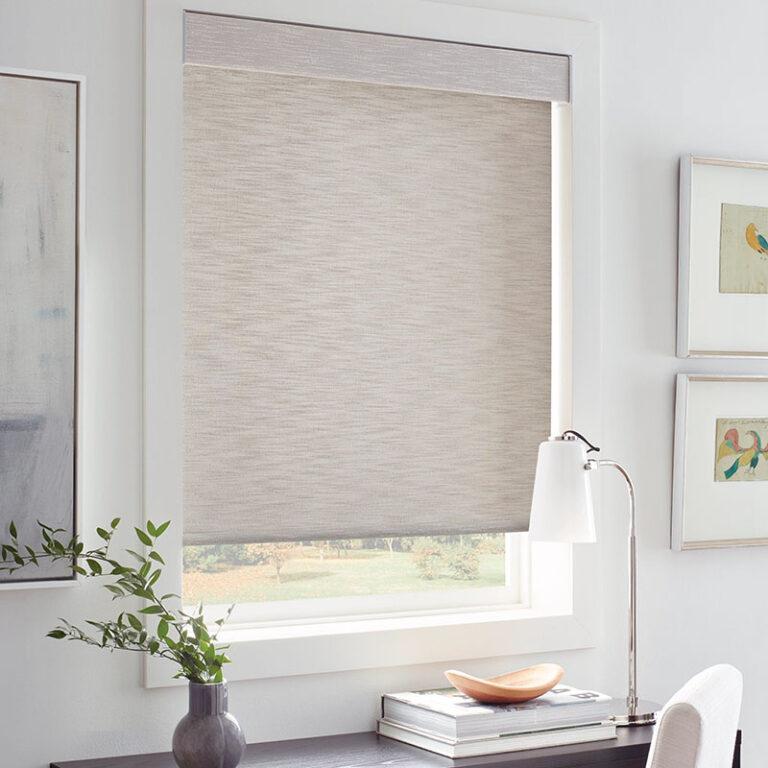
Hunter Douglas roller shades are custom fabric shades that roll up around a tube at the top of the window and drop to one flat, clean panel. The fabric decides the job: light-filtering, screen fabric that keeps your view, or room-darkening. They can be motorized with PowerView, so they move on a schedule or at a tap.
Roller shades are the simplest shade we sell, and that is most of their appeal. This guide covers the Hunter Douglas roller lines, how much light each fabric lets in, when motorization is worth it, and where a roller is the wrong pick. If you already know you want rollers and need styling ideas, see our tips for decorating with roller shades.
Key Takeaways
- The main Hunter Douglas roller lines are Designer Roller Shades, Designer Screen Shades, Designer Banded Shades, and Sonnette cellular roller shades.
- Pick the fabric before the style. Light-filtering, screen, and room-darkening fabrics do very different jobs in the same room.
- PowerView motorization lets roller shades follow the sun on a schedule, which matters most on tall, wide, or hard-to-reach windows.
- The honest downsides: rollers leave small light gaps at the edges, especially on inside mounts, and most insulate less than a honeycomb shade.
Which roller shade lines does Hunter Douglas make?
Hunter Douglas makes four roller lines most homeowners compare: Designer Roller, Designer Screen, Designer Banded, and Sonnette cellular rollers. Each one solves a different problem at the window (Hunter Douglas, "Roller Shades," retrieved 2026-11-09).
| Line | What it is for | Fabric and light | Insulation |
|---|---|---|---|
| Designer Roller Shades | A clean, minimal shade for any room | More than 350 fabrics, from sheer to opaque | Modest, like most flat fabrics |
| Designer Screen Shades | Cutting glare and UV while keeping the view | Screen fabrics in five opacity options | Modest; built for sun, not winter cold |
| Designer Banded Shades | Light and privacy in one roller | Alternating sheer and solid bands | Modest |
| Sonnette Cellular Roller Shades | A roller look with cellular insulation | Semi-opaque and room-darkening, with soft, diffused light | Better than a flat roller, thanks to its cellular design |
Designer Roller Shades
This is the classic roller. Hunter Douglas lists more than 350 fabrics, from sheer to opaque, in textures, prints, and patterns (Hunter Douglas, "Designer Roller Shades," retrieved 2026-11-09). Two options make it more flexible. Duolite puts a light-filtering fabric and a room-darkening fabric on one shade. Dual Roller mounts two separate shades on one bracket. In a west-facing great room in The Canyons in Castle Pines, we used dual rollers: a sheer that cuts glare and keeps the view, and a room-darkening fabric that comes down when the sun drops low.
Designer Screen Shades
Screen shades, also called solar shades, use an open-weave fabric. Hunter Douglas says they curb harsh UV rays, keep furniture and floors from fading, and preserve your view while controlling sun and glare (Hunter Douglas, "Designer Screen Shades," retrieved 2026-11-09). We put Designer Screen Shades in the office of a Pradera model home in Parker. Its windows ran nearly floor to ceiling, and the afternoon glare made the room hard to work in.
Designer Banded Shades
Banded shades alternate sheer and solid stripes on a single roller. Line the bands up to see out, or offset them for privacy (Hunter Douglas, "Different Types of Shades," retrieved 2026-11-09). They are a good fit when you want a roller's clean line with some of a blind's adjustability.
Sonnette Cellular Roller Shades
Sonnette pairs a roller with a cellular fabric that has 2-inch cells, so it adds insulation a flat roller can't. It comes in semi-opaque and room-darkening fabrics. A front-rolling option clears window handles and cranks (Hunter Douglas, "Sonnette Cellular Roller Shades," retrieved 2026-11-09). If insulation is your main goal, though, a true honeycomb shade is still the stronger choice. See our guide to energy-efficient blinds.
How much light do roller shade fabrics let in?
It depends on the fabric's opacity. Light-filtering fabrics soften the sun, screen fabrics cut glare while keeping the view, and room-darkening fabrics block most of the light.
| Fabric type | What you see and feel | Best rooms | Watch out for |
|---|---|---|---|
| Sheer or light-filtering | A soft glow and daytime privacy; the room stays bright | Living rooms, kitchens, dining rooms | Not dark enough for sleep |
| Screen or solar | Less glare and UV, and you keep the view out | Offices, great-rooms, view windows | More open weaves mean more view but less sun control |
| Room-darkening or blackout | Blocks the light coming through the fabric | Bedrooms, nurseries, media rooms | Light still leaks around the edges |
| Duolite or dual roller | Daylight and darkness from the same window | West-facing rooms, bedrooms that double as offices | A deeper bracket or headrail |
Screen fabric is sold by openness, the share of the weave that is open. Hunter Douglas's GreenScreen Sea-Tex screen fabrics, for example, each have 3% openness (Hunter Douglas, "Different Types of Shades," retrieved 2026-11-09). Two screen shades that look identical from across a room can behave very differently. How much you see out, how much anyone sees in, and how much heat gets through all change with that number. Choosing it is most of the work.
Can a roller shade be truly blackout?
The fabric can be, but the window usually isn't. A standard roller needs a little clearance at each side so the fabric can roll freely, and that is where light sneaks in. Hunter Douglas designs its rollers for minimal light gaps, but minimal is not zero. For a room that has to go fully dark, we often recommend an outside mount that overlaps the opening, a Duolite or dual roller, or a room-darkening honeycomb shade with LightLock side channels instead. See our room-darkening options.
Can Hunter Douglas roller shades be motorized?
Yes. With PowerView motorization, your roller shades move by remote, by app, by voice, or on a schedule you set once. Never touch your window coverings again.
PowerView works with Amazon Alexa, Google Assistant, and Apple Home, so shades can fold into routines you already use. Set the west windows to come down at 2 p.m. and the bedroom shades to open at sunrise. Many PowerView shades run on a rechargeable battery wand, with no electrician needed. In a new build we can plan hardwired power before drywall. Hunter Douglas's own manufacturer warranty covers motorized components for 5 years from purchase. That is separate from our lifetime product warranty and 5 years of free in-home service.
Motorization pays off most on the windows you fight with every day:
- Tall and two-story windows you can't reach without a pole or a ladder.
- Wide banks of glass, where moving six shades by hand gets old fast.
- West- and south-facing rooms, where a schedule beats the afternoon sun even when you are away.
- Kids' rooms, where no cords means one less hazard.
For the deeper dive, read our complete PowerView guide, our honest take on whether motorized shades are worth it, and how PowerView compares with entry-level kits. Building new? Read why to decide before drywall. Or see PowerView motorization.
Where do roller shades fit in a Colorado home?
Roller shades fit best where you want sun control without losing the view. In Castle Rock homes, that usually means big, bright windows facing the hard afternoon sun.
- Great-rooms and offices facing west or south. Colorado's high-altitude sun brings glare and UV. Screen shades keep the room usable and the view open.
- New builds. When we're brought in before drywall, motorized rollers can be wired properly and the headrails pocketed into the ceiling, with nothing hanging out from the wall.
- Modern and minimal rooms. A flat roller nearly disappears when it is up.
- Mixed rooms. You don't need the same product everywhere. In Pradera, the office got screen shades and the bedrooms and baths got Roman shades.
What are the downsides of roller shades?
Roller shades have two real weak spots: light gaps at the edges and limited insulation. Neither is a problem in the right room, but both matter in the wrong one.
- Edge light on inside mounts. An inside mount sits within the window frame for a tidy, built-in line, but a standard roller leaves a thin gap at each side. An outside mount overlaps the opening and blocks more of that light, at the cost of covering some trim.
- Less insulation than cellular shades. A flat fabric doesn't trap much air. The U.S. Department of Energy reports that cellular shades achieved higher energy savings than all other shading devices in national-lab simulations (U.S. Department of Energy, retrieved 2026-11-09). For a drafty room, a honeycomb shade or Sonnette is the better choice.
- Screen fabric at night. Screen shades keep your view by day. After dark, with the lights on inside, the open weave lets people see in. Bedrooms that need nighttime privacy need a solid fabric, a Duolite, or a dual roller.
- All or nothing. A single roller is up, down, or in between. It doesn't tilt like a blind. Banded shades and dual rollers are the answer when you want both light and privacy.
See roller shades in person
Fabric opacity is hard to judge on a screen. Bring your questions to our Castle Rock showroom, hold screen fabrics up to the light, and try PowerView yourself. We are Castle Rock's only Hunter Douglas showroom for interior window coverings, and an authorized Hunter Douglas dealer since 2003. Browse our custom shades, or book a free in-home consultation. We will bring samples to your windows, measure, and give you a price in one appointment. Your shades come with a lifetime product warranty, plus free in-home service for 5 years.
Frequently asked questions
- Are Hunter Douglas roller shades blackout?
- The fabric can block nearly all the light that hits it, but a standard roller leaves a small gap at the sides so it can roll freely. For a truly dark room, we recommend an outside mount that overlaps the opening, a Duolite or dual roller, or a room-darkening honeycomb shade with LightLock side channels.
- What is the difference between roller shades and screen shades?
- A screen shade is a roller shade with an open-weave fabric. Standard roller fabrics range from sheer to opaque and mainly control light and privacy. Screen fabrics cut glare and UV while keeping your view outside. The more open the weave, the more you see and the less sun it stops.
- Can I add motorization to my roller shades later?
- Plan for it up front if you can. It's easiest to decide before you order. In a new build, deciding before drywall also lets us hardwire power so there are no batteries to charge.
- Do roller shades help with energy efficiency?
- They help most with summer sun and glare, especially screen fabrics on west- and south-facing windows. Flat roller fabrics provide limited winter insulation. If a room runs cold, a honeycomb shade or a Sonnette cellular roller does more, because its cells trap air at the window.
- What affects the price of Hunter Douglas roller shades?
- The size of the window, the line and fabric you choose, the control system, and any options like Duolite or motorization. Because every shade is made to measure, we give you an exact price on the spot during your free in-home consultation.
- How do you clean screen and solar shades?
- Hunter Douglas recommends the brush attachment on your vacuum for regular cleaning. For heavier dirt, use a soft cloth dipped in mild dish soap and water.
Sources
- Hunter Douglas, "Roller Shades" (Designer Roller, Designer Screen, Designer Banded, Sonnette Cellular lines; minimal light gaps) (retrieved 2026-11-09)
- Hunter Douglas, "Designer Roller Shades" (more than 350 fabrics from sheer to opaque; Duolite and Dual Roller options) (retrieved 2026-11-09)
- Hunter Douglas Help Center, "What is the warranty for motorized components?" (five-year limited warranty from purchase, original owner) (retrieved 2026-11-09)
- Hunter Douglas, "Designer Screen Shades" (UV protection, five fabric opacities, view preservation) (retrieved 2026-11-09)
- Hunter Douglas, "Sonnette Cellular Roller Shades" (2-inch cells, semi-opaque and room-darkening fabrics, front-rolling option) (retrieved 2026-11-09)
- Hunter Douglas, "Different Types of Shades" (banded shades, GreenScreen Sea-Tex 3% openness, solar shade cleaning) (retrieved 2026-11-09)
- U.S. Department of Energy, "Interior Cellular Shades Boost Home Energy Performance" (retrieved 2026-11-09)
About the author
Lucas Campbell · Business Development, Value Blinds & Shutters
Lucas Campbell joined Value Blinds & Shutters full time in 2023 and works with homeowners across Castle Rock and the Front Range. Value Blinds is the only Hunter Douglas showroom for interior window coverings in Castle Rock and an authorized Hunter Douglas dealer since 2003.